
The Cure for High Grain Prices
???? Fundamentals
U.S. Grain production is expected to increase sharply, with record harvests seen in both Corn and Soybeans this coming growing season, as producers respond to relatively high prices due to last season’s drought. This was the forecast by the USDA at its annual Outlook Forum.
USDA economists are forecasting a U.S. Corn crop of 14.350 billion bushels, which if accurate would be a jump of 35% from last season. The U.S. Soybean crop is estimated at 3.405 billion bushels, which would be up a more modest 13% from last year. The USDA is estimating acreage planted to Corn at 96.5 million acres, and to Soybeans at 77.5 million acres.
The USDA production estimates assume that yields will return to trend after the worst drought since the 1930’s devastated crops last year. The effects on cash market prices could be dramatic, with the USDA lowering its estimate for the average 2013-14 Corn and Soybean prices by 33% and 27% respectively.
Cotton production appears to be the biggest loser in the battle for acreage this coming year, as huge global supplies and higher potential profit margins for both Corn and Soybeans should encourage less acres to be dedicated to Cotton, with the USDA looking for only 9.8 million acres being planted this season.
Some traders will be eagerly anticipating the official USDA prospective plantings report on March 28th, which will give the first real glimpse as to what producers actually expect to plant this coming season.
???? Technical Notes
Looking at the daily chart for new-crop November Soybeans, we notice prices initially rebounding on Friday, following a moderate sell-off on Thursday, after the USDA Soybean plantings estimate was released. However, the price gains were short?lived, as the market closed sharply lower to end the trading week.
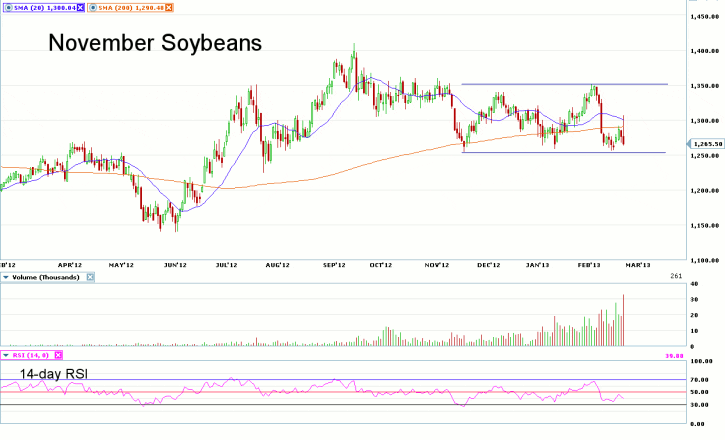
The current new-crop Corn vs. Soybean price ratio of 2.328 is near the 30-plus year average, but is on the lower end of the price range seen since 2008. This may favor Soybean prices gaining moderately versus Corn prices to encourage adequate Soybean acreage. Prices are hovering close to both the 20 and 200-day moving averages, as prices are currently near the middle of a $1-wide consolidation range seen since November of last year. The 14-day RSI is turning weaker, with a current reading of 39.88. Support for November Soybeans is found at the November 16th low of 1255.25, with resistance found at the February 4th high of 1350.75.
—————————————————————————————-
Disclaimers
This article is provided for informational purposes only. No statement in this article should be construed as a recommendation to buy or sell a security or to provide investment advice. The content provided has been obtained from sources deemed reliable but is not guaranteed as to accuracy and completeness. optionsXpress makes every effort to provide timely information to its recipients but cannot guarantee specific delivery times due to factors beyond our control.
Derivatives involve substantial risk and are not appropriate for all investors. Please read the “”Disclosure Statement for Futures and Options”” prior to investing in futures or options.
For investments using a straddle or strangle options strategy the potential loss is unlimited. Multi-leg option strategies are subject to multiple commissions. Profits may be eroded by the commission expended to open and close the positions and other risks apply.