
Cotton Consolidation Continues
Today’s Spotlight Market
The first ?official? forecast from the USDA for the 2014-15 Cotton market will not be released until February of next year. However, traders and analysts are already starting to analyze potentially likely supply and demand scenarios that could determine what type of market we will see for Cotton in 2014.
The biggest element of any forecast is what will be the Chinese government?s intention in regards to further purchases for state-owned reserves. Any rally in prices may curtail further purchases as China may decide to unload some of its huge reserves on domestic users in order to help curb inflationary pressures. However, should global prices begin to weaken; we may see China aggressively import Cotton, despite already large supplies, in order to take advantage of lower prices. ?
Fundamentals
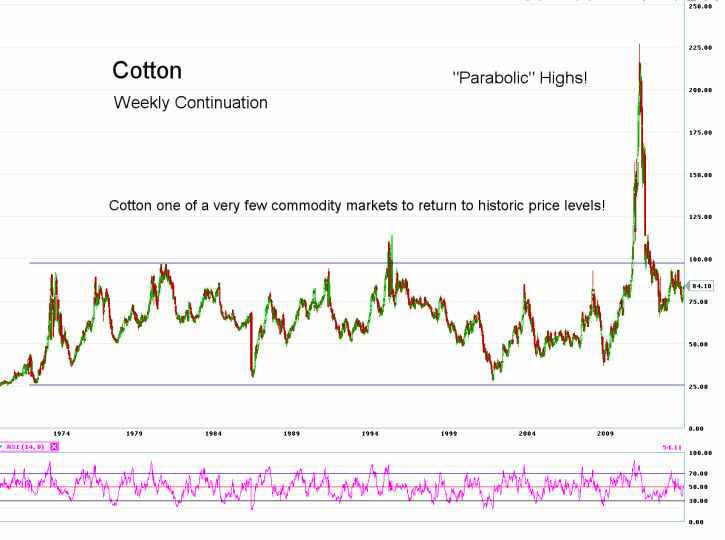
After an historic price spike during the 2010-11 season, Cotton prices have returned to their historic price range of the past 40 or so years despite large purchases by China the past year. China appears to be taking advantage of sharply lower Cotton prices this past year to replenish state-owned reserves, which were depleted during the 2010-11 bull market when Cotton prices traded over the $2 per pound price level.
As we are nearing the start of 2014, the outlook for Cotton prices is mixed, with bulls noting an improving global economic outlook that could spur increased demand for commodities including Cotton. In addition, with new-crop Cotton prices currently below 78 cents per pound, many analysts believe that U.S. Cotton production will fall next season, as alternate crops, such as Soybeans, become more attractive for producers to plant given current market prices.
On the other side of the Cotton equation, market bears will argue that the large Chinese purchases will help to curb demand next year as the world?s largest Cotton producing and consuming nation begins to sell some of the state owned reserves in the domestic market. Either way it does appear that baring a major supply shock, Cotton prices may remain range bound next year as the market appears to be near a supply and demand equilibrium, with prices expected to remain within a 20 cent price range from current prices.
Technical Notes? -? View Today’s Chart
Looking at the weekly continuation chart for Cotton futures going back to the early 1970?s, we notice prices have generally traded within a 75-cent per pound price band for most of the last 40 years. The big exception being the 2010-11 season when prices went ?parabolic?, soaring to an almost unthinkable $2 per pound level at a time when prices over $1 per pound were a very rare occurrence. We need to note however, that prices became extremely unstable at those lofty levels as end-user demand plummeted and global production rebounded which gave further credence to the old adage that ?the cure for high prices is high prices? and shows that some of what we learned in economics class about the supply and demand curve vs. prices actually works in the ?real world? occasionally!
—————————————————————————————————–
Disclaimers
This article is provided for informational purposes only. No statement in this article should be construed as a recommendation to buy or sell a security or to provide investment advice. The content provided has been obtained from sources deemed reliable but is not guaranteed as to accuracy and completeness. optionsXpress makes every effort to provide timely information to its recipients but cannot guarantee specific delivery times due to factors beyond our control.
Derivatives involve substantial risk and are not appropriate for all investors. Please read the?“Disclosure Statement for Futures and Options”?prior to investing in futures or options.
For investments using a straddle or strangle options strategy the potential loss is unlimited. Multi-leg option strategies are subject to multiple commissions. Profits may be eroded by the commission expended to open and close the positions and?other risks?apply.