
Copper Prices Stagnant Despite Fed Tapering
Today’s Spotlight Market
Speculators are holding a net-short position in COMEX Copper, with the most recent Commitment of Traders report showing the combined non-commercial and non-reportable position totaling a net-short 17,314 contracts as of December 10th. This net-short speculative position will be put to test by the rebalancing of commodity index funds, with the DJ-UBS commodity index increasing the weighting of Copper by 0.23% to 7.51%, which will require index fund managers to purchase Copper contracts early in 2014. ?
Fundamentals
Copper traders have seen a rather tranquil last half of 2013, as the market moved into a consolidation mode following a steep sell-off in prices at the start of the year. The Copper market appears trapped between conflicting fundamentals, with bulls touting the steady drawdown of Copper stocks in LME warehouses, which are currently over 40% lower than the highs seen back in June.
In addition, China?s State Reserve Bureau (SRB) is planning on building state-owned reserves of industrial metals in 2014, including potentially 300,000 tons of Copper and nearly 150,000 tons of Nickel. The SRB has a goal of accumulating 2 million tons of Copper by 2015, and may be an aggressive buyer on price dips.
In the bearish camp, we note Copper prices are well above historic price levels, although the huge appetite for commodities out of China may be contributing to a ?new normal? price range for the red metal for years to come. The news last week that the Federal Reserve would begin to taper-back its bond purchases by 10 billion per month has triggered a strengthening of the U.S. Dollar, which is generally viewed as bearish for commodities priced in Dollars, as it makes purchases more expensive for non-Dollar users.?
As we head into 2014, it appears that the direction for Copper prices may depend on whether the global economy continues to gain traction, which should help to support commodity prices including Copper.? Or, will a stronger Dollar combined with sluggish economic growth prospects curb commodity demand and keep Copper prices well below recent historic highs. ?
Technical Notes? -? View Today’s Chart
Looking at the weekly continuation chart for Copper, we notice that until 2005, Copper?s upper price band was $1.50 per pound, but that all changed once China?s huge appetite for commodities combined with the start of the parabolic price move in the U.S. housing market sent Copper prices to record highs that reached well over $4.50 per pound in 2011. Of particular interest is the violent move that occurred once the ?bubble? burst in the U.S. housing market, with Copper prices falling from record highs, which were at the time above $4, to a low near $1.25 per pound, at the nadir of the financial crisis.
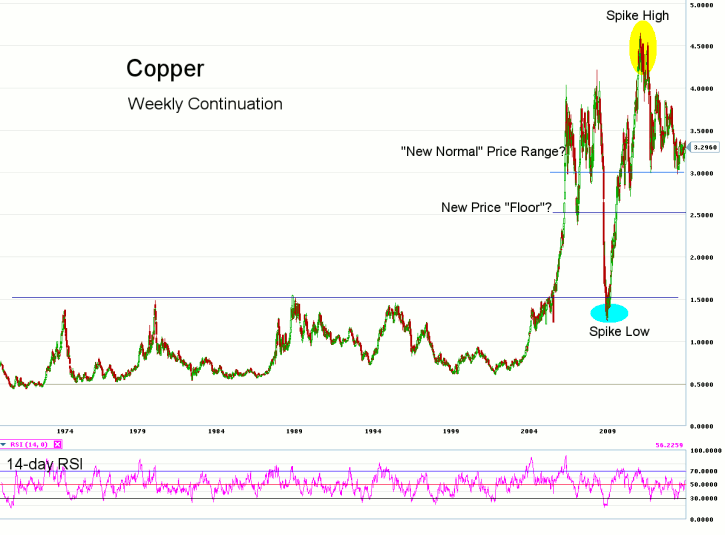
The price move back into the historic price range was very short?lived, as prices made new all-time highs just 2 years after the price collapse. This seems to confirm the belief that Copper prices may now be trading in a new more elevated price band, with a floor now seen between $2.50 and $2.75 per pound, as opposed to the previous historic price support level around $0.50 per pound.?
————————————————————————————-
Disclaimers
This article is provided for informational purposes only. No statement in this article should be construed as a recommendation to buy or sell a security or to provide investment advice. The content provided has been obtained from sources deemed reliable but is not guaranteed as to accuracy and completeness. optionsXpress makes every effort to provide timely information to its recipients but cannot guarantee specific delivery times due to factors beyond our control.
Derivatives involve substantial risk and are not appropriate for all investors. Please read the?“Disclosure Statement for Futures and Options”?prior to investing in futures or options.
For investments using a straddle or strangle options strategy the potential loss is unlimited. Multi-leg option strategies are subject to multiple commissions. Profits may be eroded by the commission expended to open and close the positions and?other risks?apply.