
“Swing and a Miss” for Analysts on March Jobs Data
???? Fundamentals
April has arrived, and thoughts turn to the upcoming baseball season. It is generally believed that pitchers have an advantage over hitters early in the season. In the case of the Non-Farm Payrolls report for March, it appears that Labor Department statisticians had the upper-hand on traders and economists, as pre-report estimates were widely off the mark.
March non-farm payrolls came in at a weak 88,000 jobs, which is well below the widely varied estimates of between 150,000 and 210,000 jobs most traders were anticipating. All of the gains were seen in the private sector, which created 95,000 jobs last month.
Ironically, the unemployment rate declined by 0.1% to 7.6%, which also caught pundits off guard. The details show a mixed bag for employment sectors, with gains seen in business services and health care, but payroll cuts found in the retail and manufacturing sectors. Public sector jobs continue to be shed, falling by 7,000 jobs last month, although Federal government jobs fell by 14,000.
Though we did see a small decline in the unemployment rate, which is now at its lowest levels since December 2008, it was a decline of almost 500,000 participants from the workforce that accounted for the lower rate. This continued slow growth in employment gave traders another reason to ignore those expecting the Federal Reserve to reduce its “stimulus” program in the coming months.
Market participants’ reaction to the payrolls was of little surprise, with equity index futures falling sharply and U.S. Bond futures rallying to highs not seen since January. Bond prices may also be seeing renewed interest after the Bank of Japan’s announcement of aggressive actions to help stimulate its moribund economy.
So even though U.S. interest rates are at historically low levels, they still look attractive to investors in both Europe and Japan, where both German Bunds and Japanese Government Bonds are trading at even lower yields than that of U.S. government debt.
???? Technical Notes
Looking at the daily continuation chart for U.S. Treasury Bond futures, we notice what might be interpreted as a head and shoulders bottom formation, with prices now breaking out from the neckline. In addition, Friday’s price surge brought prices back above the 200-day moving average (MA) for the first time since late December.
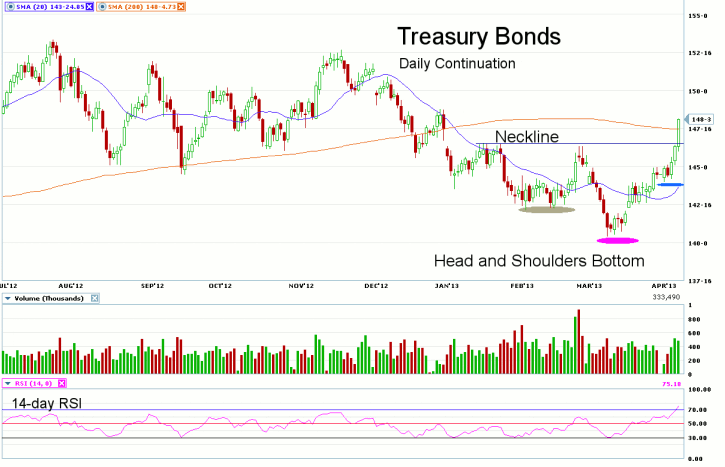
The 14-day RSI is surging higher and has now reached overbought levels, with a current reading of 75.18. The next upside resistance level is found at the December 28th high of 148-25. Support is seen at the 20-day MA, currently near the 143-22 price level.
——————————————————————————————————
Disclaimers
This article is provided for informational purposes only. No statement in this article should be construed as a recommendation to buy or sell a security or to provide investment advice. The content provided has been obtained from sources deemed reliable but is not guaranteed as to accuracy and completeness. optionsXpress makes every effort to provide timely information to its recipients but cannot guarantee specific delivery times due to factors beyond our control.
Derivatives involve substantial risk and are not appropriate for all investors. Please read the “”Disclosure Statement for Futures and Options”” prior to investing in futures or options.
For investments using a straddle or strangle options strategy the potential loss is unlimited. Multi-leg option strategies are subject to multiple commissions. Profits may be eroded by the commission expended to open and close the positions and other risks apply.