
The time has come to update Volatility Kings.
At the end of the first quarter, the time has come to update Volatility Kings? our list of companies having a tendency to experience increasing option implied volatility as their quarterly reporting dates approach reflecting greater uncertainty or the width of the possible stock price distribution on the report date.
However, the degree of uncertainty for the current reports may not be comparable to previous quarters. Indeed, some companies are on the list one quarter and not the next while others seem to remain on our list quarter after quarter. Since the focus is on earnings, others with high-implied volatility due to takeover speculation or FDA announcements do not appear along with those lacking sufficient liquidity due to low option volume.
First, a brief comment about last week,
S&P 500 Index (SPX) advanced 66.65 or 3.22% points for the week after trading as low as 1991.68 last Monday. Contrary to expectations that the post Brexit decline would continue lower and last longer as suggested last week.?It reversed Tuesday, returning to within 10.37 points of the 6-23 pre-Brexit high. The VIX futures premium came back from negative -12.72 to 17.93% as VIX quickly declined last Tuesday prompting a good bit of short covering?Wednesday and Thursday producing hedging losses. However, there could still be more to come about this Brexit story as gold and silver breakouts may imply, and then there is the non-farm payroll report Friday to consider.
The search begins for stock prices greater than 5 since when prices are too low, there are usually not enough strike prices or liquidity for spreads or other strategies, with the possible exception of short puts that come with assignment risk.
Next options volume: This could result being included one quarter and not the next, but the objective is to find those stocks with sufficient options liquidity and therefore reasonable bid/ask spreads to use for various multiple leg strategies, such as Calendar Spreads, Butterflies, Iron Condors and others.
1-week average option volume greater than 20K contracts
1-month average option volume greater than 20K contracts
For volume, we start with the “Top 200 stocks by volume / open interest” link on the left side of the ?Rankers and Scanner? section of our home page where we feature a complimentary ranker sample of the top 200 stocks and ETFs by Options volume and Options open interest displaying weekly averages.
Then the Implied Volatility differential from last quarters? earnings announcement high to the subsequent after reporting low needs to be greater than 10%, occurring regularly with some flexibility on the regularly occurring requirement as it may vary due to market conditions and special situations.
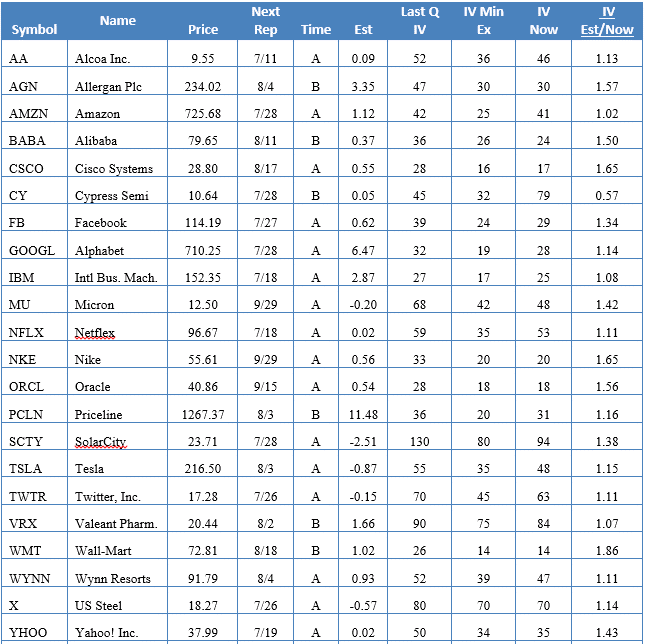
For the data table above, descriptions and details for the column headings follow.
Price in column 3, are closing stock prices as of Friday July 1, 2016.
Next Rpt in column 4 is the next expected reporting date. They require checking often as these are only estimates and companies routinely change reporting dates. Time in column 5 is the time during the day to expect the report, where B is before the open, A is after close.
Estimate in column 6 is the current consensus earnings estimate per share, also subject to change before the report date. Some may also have higher or lower “whisper” estimates. In addition, stock prices are moving on forward guidance as much or perhaps more than revenues and earnings.
Last Q IV in column 7 is the implied volatility index mean (IVXM) of the puts and calls reached just before the last quarterly report, but may not necessarily be relevant this quarter.
IV Min Ex in column 8 shows the implied volatility index mean (IVXM) low after the last earnings report making it easier to compare the pre-report high to the subsequent low. For some, depending upon the last report date, the implied volatility may still be declining, for example, Micron (MU)
IV Now in column 9is the implied volatility index mean, (IVXM) as of Friday July 1, 2016.
IV Est/Now in column 10 is the ratio of the estimated implied volatility to the current implied volatility based primarily on the high reached the previous quarter. Those with higher ratios have a potentially greater opportunity to increase going into their next report date and many have already started increasing anticipating the next report.
Nike (NKE) and Oracle (ORCL) recently reported so the implied volatility may still be declining so compare the current IV Now to the previous IV Min EX to estimate the potential implied volatility decline or the next advance sequence.
Alibaba (BABA), Cisco (CSCO) and Wal-Mart (WMT) all appear to have reached lows after their last reports and are now starting to advance in anticipation of their second quarter reports.
Summary
Although equities initially declined on the Brexit news they quickly recovered as “buy the dip” along with short covering pushed the S&P 500 Index back up to within a few points of where it began the week. However, the British pound, US Treasury Notes and Bonds, gold and silver, suggest there may still be more to this story. As for the equity round trip,