
United States Oil (USO)
There are several reasons for choosing USO for our downside suggestion including the fairly high 10 day correlation of 78% with S&P 500 Index along with the recent seasonal pattern that has seen crude oil decline from February – early March highs to June lows the last two years. Checking the long-term record, crude oil usually advances in the spring, but that was not the case in 2011 or 2012 and we think the odds favor another decline this spring since there is more available crude oil than refinery capacity. In its latest release, based on February 15, 2013 data, the U.S. Energy Information Administration (EIA) reports, “U.S. commercial crude oil inventories (excluding those in the Strategic Petroleum Reserve) increased by 4.1 million barrels from the previous week. At 376.4 million barrels, U.S. crude oil inventories are well above the upper limit of the average range for this time of year.”
Here is the USO chart.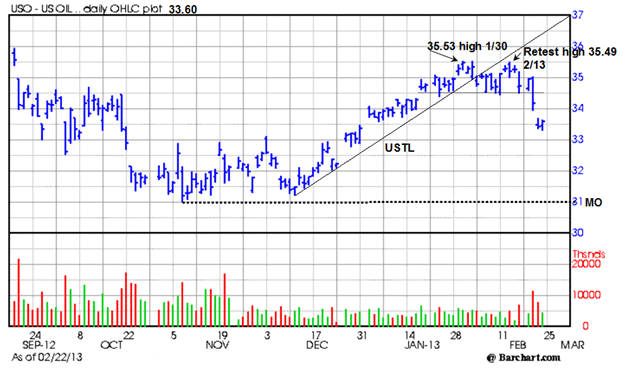 ?
?
After advancing along with equities from the December 11 low at 31.49 it made a well-defined multi-point upward sloping trendline, shown above as USTL reaching a high of 35.53 on January 30. It then made several closes below the trendline before retesting the high on February 13 reaching 35.49 before rolling over to close below the 34.50 support level after the EIA report on Wednesday February 20 setting off a classic double top reversal pattern. We think the downside measuring objective is much below the one determined by the double top and have set it at the November 17 low of 31where it may find support, see MO above.
In addition to its correlation with equities and the fundamental oversupply, there are two other reasons for using USO relating to edge.
Since USO uses front month futures contracts continuously rolled out at higher prices when the term structure is in contango, as now, it means there is a rollover loss, currently about 1%.
Second, due to the options market skew out-of-the money puts are more expensive as defined by implied volatility than at-the-money puts. When using vertical put spreads the options sold are more expensive, but with less gamma than the long ATM puts meaning the combination produces very favorable risk to reward ratios as shown by the March and April trade ideas below.
First the options data.
The current Historical Volatility is 15.36 and 12.76 using the Parkinson’s range method, with an Implied Volatility Index Mean of 22.17, up from 19.42 last week. The IV/HV ratio is 1.44 and 1.74 using the range method to calculate the HV. Friday’s put-call ratio at .50 was bullish while the volume was 98,473 contracts traded compared to the 5-day average volume of 115, 750.
Consider these alternatives
The debit cost at .55 is 22% of the distance between the strike prices means the risk to reward ratio is a very favorable 3.5 to 1, but there is only 19 days to expiration. The delta is a negative .3386 with .1401 gamma or rate of change of delta. The time decay or theta is -.0071 with vega, or sensitivity to changing implied volatility of .0172.
The April alternative has a debit cost of .71 with the distance between the strike prices of 2.5 for a risk to reward ratio of 2.5 to 1 and 54 days to expiration allowing some time for a counter trend rally in the event the downward momentum slows. Comparing the delta and gamma, both are lower than March along with less time decay and a bit less vega as well.
The price objective is the MO at 31, along with an increase in implied volatility from 22.17 to 30 based upon reversion to the mean since it has been below normal. Use a close back above 34 that would close the gap as the SU (stop/unwind).