
Volatility Trading Digest – Super Mario Delivers
Although some remain skeptical many others think the ECB’s Outright Monetary Transactions program is quite clever as it seems to offer the markets a credible plan to regain control of interest rates and counter speculation of a currency breakup. At the same time, China announced approvals for substantial new subway and highway projects in an effort to revive economic growth.
In addition, this week the markets are anticipating Ben Bernake will announce additional stimulus measures after the Federal Open Market Committee meeting on Wednesday and Thursday.
In this issue, we look at the VIX futures premium, update our previous VIX hedge trade and offer a supplemental idea for another, followed by three ideas for China and a new volatility suggestion.
Strategy
Last week we said without some unexpected good news from Europe or the Federal Open Market Committee the likely direction for equities was a down toward the trendline at 1380. It turns out the news from Europe was better than expected and then enhanced by more positive news from China. Then after the weak employment report last Friday, it now seems inevitable there will be another stimulus program coming from the Federal Reserve. As a result, the usual September seasonal weakness is now just a dim memory in the rear view mirror as the S&P 500 Index (SPX) closed above the previous April 2 resistance high at 1422.38, and even closed above the August 21 key reversal high at 1426.88.? ?
As the bears scrambled to cover their shorts we suggest closing any open hedge positions and increase longs especially in the economic sensitive groups and companies with sizeable activity in China since they have been relatively weak.
S&P 500 Index Implied Volatility (IVXM)
By the end of last week, the Implied Volatility Index Mean had declined from 15.37 to 12.35, while the CBOE Volatility Index? (VIX) declined from 17.47 to 14.38.
The table below shows the VIX cash compared to the next two futures contracts as well as our calculation of Larry McMillan’s day-weighted average between the first and second months.

The day weighting applied 35% to September and 65% to October resulting in the average premium of 2.29 or 15.90% shown above. Our alternative volume weighting between September and October calculates to be a 12.99% premium. Last week the day-weighted premium was 13.53% and the volume weighted was 13.60%. However, the futures volume increased to 124,243 contracts as the open interest expanded to 402,664 contracts, approaching the August 21 key reversal high of 403,608 contracts.
As a further cautionary note, the VIX options traded 1,040,935 contracts compared to the 5-day average of 507,950 contracts, as the call volume was in excess of 600,000 contracts, suggesting considerable call hedging activity.
For this short-term indicator the premium to the cash is a SPX sell signal suggesting professional expectations for the cash to increase toward the futures price. In the past premiums in excess of 20%, have usually preceded corrections, although not a precise timing tool it appears to be a good way to measure professional hedging sentiment, which is now back into the normal range although the volume has increased.
CBOE Volatility Index? (VIX)
The pricing for the VIX options are from the futures, and we used the September 19 options for our synthetic long hedge suggestion from two weeks ago that we implemented with a .17 credit. With VIX decline, the mark-to market value of the position was negative by 3.75. Although the rapid decline appears unsustainable and is likely to reverse somewhat in the next few days we will close this hedge and not attempt to adjust it since we still have eleven open longs that did well last week gaining more than 3.75 with the market advance. Since this rally could go for some time, we suggest following the path of least resistance.
First Solar, Inc. (FSLR)
This is an update for a put sale suggestion make in Digest Issue 32. Since the September 15 is likely to expire out-of-the money soon and the stock has made reversal pivot higher we suggest adding new position.
The options data follows.
The current Historical Volatility is 109.62 and 75.78 using the Parkinson’s range method, with an Implied Volatility Index Mean of 81.11, down from 84.32 last week. The IV/HV ratio is .74 and 1.07 using the range method to calculate the HV. Friday’s put-call ratio was just bullish at .60, while the volume was 38,895 contracts traded compared to the 5-day average volume of 47,110.
As the bulls and bears debate the fundamentals of the solar industry, their next earnings report is due October 31 with a consensus estimate of 1.09 per share.
After gapping open on the last earnings report and trading up to 26, it corrected back to 18 and has now made a pivot and turned higher once again. On the decline, the implied volatility increased and now we are expecting it will decline, as the stock again turns higher.
Here is long call spread short put combination to consider.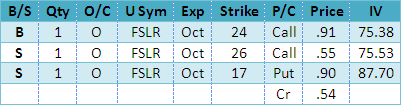
The implied volatilities of the calls are about even and the spread cost of .36 is only 18% of the distance between the strike prices making for an attractive risk reward ratio. In addition, there is a decent edge in the short put, especially if we are right and implied volatility continues to decline. Use a close back below the most recent pivot at 18.30 as the SU (stop/unwind).