
Volatility Trading Digest – China Stimulus & Third Quarter Earnings Plan
China Stimulus
Since the 800 billion renminbi infrastructure stimulus plan announced last week reversed the long decline that began last April, we are expecting the advance to continue and help reverse the recent declines in many of the cyclical sectors. Here are three ideas.
iShares FTSE China 25 Index Fund (FXI)
We are selecting this ETF in part to reduce the risk of using individual China listed stocks, some of which are having accounting and reporting issues.
The current Historical Volatility is 18.32 and 10.69 using the Parkinson’s range method, with an Implied Volatility Index Mean of 21.22, up from 20.45 last week. The IV/HV ratio is 1.18 and 1.99 using the range method to calculate the HV. Friday’s put-call ratio was quite bullish at .30, while the volume was 193,249 contracts traded compared to the 5-day average volume of 157,920.
Look at this call spread.
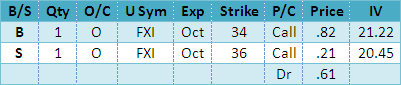
Although there is no volatility edge, it is a low cost way to participate in the upside, should it continue as we expect. Use a close back below the last pivot at 32 as the SU (stop/unwind).
Now for two US listed companies that have substantial operations in China and Southeast Asia that should benefit from the new China stimulus plan.
Tiffany & Co. (TIF)
With a bullish rank of 77.78, TIF has 58 stores producing 21% of their revenue in the Asia-Pacific region. Japan adds another 55 stores and 17% more revenue.
The current Historical Volatility is 33.90 and 23.47 using the Parkinson’s range method, with an Implied Volatility Index Mean of 27.00, down from 27.63 last week. The IV/HV ratio is .80 and 1.15 using the range method to calculate the HV. Friday’s put-call ratio was in bearish territory at 1.15, while the volume was just 8,017 contracts traded, but more than the 5-day average volume of 6,790.
Here is another call spread short put idea.
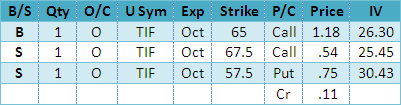
With a reasonable edge in the short put and a good call spread risk reward ratio, use a close back below the last pivot at 59.01 as the SU (stop/unwind).
Las Vegas Sands Corp. (LVS)
With improving conditions in Asia from the China stimulus and with a substantial portion of its revenue coming from Macau and Singapore, LVS should be able to challenge its April high at 60.
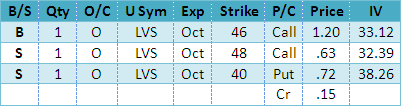
Two weeks ago, we suggested the sale of a September 35 put that is out-of-the-money and nearing expiration. Here is a replacement suggestion that will benefit assuming the uptrend continues.
The current Historical Volatility is 32.48 and 29.17 using the Parkinson’s range method, with an Implied Volatility Index Mean of 33.71, down from 36.42 last week. The IV/HV ratio is 1.04 and 1.16 using the range method to calculate the HV. Friday’s put-call ratio was in just bullish at .65, while the volume was 49,603 contracts traded, more than the 5-day average volume of 32,500.
 ?
?
The call spread has a reasonable risk reward ratio since the .57 debit is 28.5% of the distance between the two strikes. Use a close back below the last pivot at 40 as the SU (stop/unwind).
Third Quarter Earnings Plan
It is time to start planning for 3Q earnings reports, especially for the ones that usually experience increasing implied volatility going into their report date.
This one, ranked number five in Friday’s increasing implied volatility scan with a gain of 3.94 or 6.97% to 60.49, got our attention since it has a history of reaching over 100 on earnings reports.
Green Mountain Coffee Roasters Inc. (GMCR)
The current Historical Volatility is 89.88 and 62.88 using the Parkinson’s range method, with an Implied Volatility Index Mean of 60.49, down from 60.60 last week. The IV/HV ratio is .67 and .96 using the range method to calculate the HV. Friday’s put-call ratio was just bearish at .80, while the volume was a whopping 104,393 contracts traded, compared to the 5-day average volume of 33,010.
Since this is a volatility trade, we suggest using a long dated straddle.
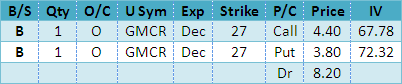
Since the next earnings report date comes after the October options expire, we will use the December options with 102 days to expiration. This will minimize our time decay loss and maximize vega while the implied volatility increases. As for a stop, we will close the position if the implied volatility index mean is less than 70 in 30 day’s time.
All of the suggestions above use the closing middle price between the Friday bid and ask. Monday, the option prices will be somewhat different due to the time decay over the weekend and any price change.
?
Summary
The combination of the ECB’s Outright Monetary Transactions program, China’s new infrastructure stimulus news and expectations for additional stimulus from the Federal Reserve coming this week scared the bears enough to cover their shorts, however since the fundamentals are still weak it remains to be seen just how much higher equities can go. In the meanwhile, we will go with the flow.