
Originally introduced late last year, Volatility Kings presents a list of companies having a tendency to experience increasing options implied volatility as their quarterly reporting dates approach. The increasing implied volatility reflects uncertainty or the width of the possible stock price distribution on the report date. While these companies have experienced increasing implied volatility when they previously reported, the level of uncertainty for the current report may not be comparable. Indeed some companies are included one quarter and not the next while others seem to remain quarter after quarter. Since the focus is on earnings, others with high-implied volatility due to takeover speculation and FDA announcement dates are not included along with some stocks with low options volume.
For 4Q 2012 earnings, here is the complete updated master list.
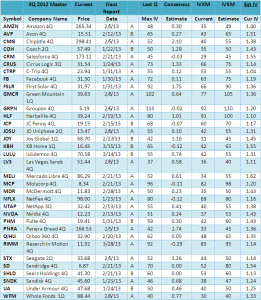
Current Price in column 3 are the closing prices Thursday January 10 while IVXM Current in column 8 are the closing numbers on January 8 where IVXM is the Implied Volatility Index Mean.
A or B in column 5 indicates when during the day to expect the report release, After the close or Before the opening.
Last Q Max IV in column 6 is the maximum implied volatility reached at the previous report date and used as the basis for estimating the IV for the upcoming report.
IXVM Current in column 8 is the Implied Volatility Index Mean now, while the IVXM Estimate in column 9 is an estimate based mostly on the previous quarter maximum. Est IV/Cur IV is the ratio between the Estimate IV at the upcoming earnings date and the current IV. The higher ratios such as CRM, KBH, MELI, could provide the best opportunity for increases.
From the Master List it is easy to create others focused on January announcements or February announcements using an Excel spreadsheet with its filter function on column 4.
The difference between the current implied volatility and the estimate is more important than the highest estimated value as it measures the potential increase. The Est/IV Cur IV value for LVS in Column 10 is 1.11, while the next on down, MELI is 1.62.
The typical pattern is a decline on the report date lasting about 9-10 weeks followed by a subsequent rise about 2-3 weeks before the next report date, but they vary and each has its own pattern.
As we explained in Digest Issue 38, straddles or strangles are two alternatives to use going into the reporting dates with plans to close them just before the report. The estimated implied volatility at the report date is a guideline based upon the most recent reports and may not be relevant in the current quarter. The actual reporting dates need scrutiny since they vary by the data source and are subject to change by the reporting companies.
Frequently calendar spreads are used for quarterly reporting by selling the near term option with higher implied volatility and buying the same strike price in the deferred month with a lower implied volatility, however since it has short gamma, or the rate of change of delta, any large move in the underlying on the report will result in a loss.
Option prices continuously change in response to changing expectations. The higher the uncertainty the more valuable the option, implying there is a much wider distribution of possible outcomes.
Although there are shortcomings, implied volatility is a way to quantify stock price uncertainty.
As for earnings reports, the range of earnings estimates or the difference between the high and low estimate for the upcoming earnings report reflects uncertainty. Those with high and rising IV going into the report usually have a tendency to show a greater divergence of opinion between the analysts, which seems very logical.
Since the list is constantly changing, we can use your help identifying new candidates. If you have any suggestions please let us know.