
From the S&P 500 Index (SPX) perspective the breakout and close above the September 14 high at 1474.51 confirms a new uptrend measured from the November 16 low at 1343.35 with the December 31 reversal low of 1398.11 making the second point for our upward sloping trendline as shown on the chart below.
First, we update our market indicators and then follow with another iShares Russell 2000 Index (IWM) trend continuation idea.
S&P 500 Index (SPX)
Using the SPDR S&P 500 (SPY) to measure the volume we see Thursday’s breakout of 133.8 million shares was not very convincing since we know low volume breakouts are not reliable. Friday’s volume of 169.9 was better, but volume that is more convincing would have been closer to 200 million, like January 2 on the gap up volume of 192 million. However, since the breakout is still early the volume could rise further in the next few days.
S&P 500 Index Implied Volatility (IVXM)
Since our last review, the Implied Volatility Index Mean declined from 12.06 to 10.59, while the CBOE Volatility Index? (VIX) declined from 13.83 to 12.46.
The table below shows the VIX cash compared to the next two futures contracts as well as our calculation of Larry McMillan’s day-weighted average between the first and second months.

The day weighting applies 85% to February and 15% to March for an average premium of 19.54% shown above. Our alternative volume weighting between February and March is 22.51%. The premiums over the cash VIX are now at the upper end of the normal range suggesting higher bids by professional hedgers expecting the VIX to rise when the SPX retests the breakout.
iPath S&P 500 VIX Short Term Futures ETN (VXX)
The five-day average volume was 27.04 million shares with 45.5 million on Friday as it declined 1.65 points.
VelocityShares Daily Inverse VIX Short Term ETN (XIV)
The 5-day average volume for the inverse was 10.02 million shares with the greatest volume of 11.2 million on Friday.
The declining volume of the XIV appears to be a reason for the increasing VIX futures premium. The long VXX usually trades between 1.5 and 2.5 times as many contracts as the short XIV, but declining relative XIV volume increases the VIX premium. The 5-day average was 2.70, with Friday’s ratio at 4.06. When the term structure is in contango, or it slopes upward over time, the advantage goes to a long XIV position since it represents a short futures position and VXX continuously sells the near term contract and buys the next longer term contract at a higher price.
Friday’s VIX futures volume was 154,877 contracts while the open interest declined from 449,816 the week before to 425,822.
VIX Options
With a current 30-day Historical Volatility of 117.07 and 73.15 using Parkinson’s range method, the table below shows the Implied Volatility (IV) of the at-the-money VIX calls and puts using the futures prices based upon Friday’s closing option mid prices along with their respective month’s futures prices, since the options are priced from the tradable futures.
Using the IV Index Mean of 54.23 the IV/HV ratio is .46, using the range method for Historical Volatility the ratio is .74 while the VIX put-call ratio at .38 is bull for VIX, but not for the SPX with a put-call ratio of 1.50, since they move in opposite directions. Friday’s options volume was 806,301 contracts compared to the 5-day average of 686,560.
The equity only put call ratio was .54 making the spread between the SPX put-call ratio and the VIX put-call ratio .16. Correcting our previous comment, a narrower spread is bullish since means the VIX put-call ratio relative to the SPX call ratio is lower. As the SPX put call ratio increases it becomes more bearish while the VIX put-call ratio is more bearish (for the SPX) as the ratio declines making the spread between them wider.
iShares Barclays 7-10 Year Treasury (IEF)
Interest rates now at 1.84 have declined from 1.96 on January 4 as equities moved higher. For now there appears to be less concern that rates will continue higher after briefly testing and quickly rebounding from support at 106.50.
iShares Dow Jones Transportation Average Index (IYT)
As probably the single most important leading indicator for the economy, the transports are in a strong uptrend and now well above the previous 86-95 range. In addition to being an important Dow Theory confirming indicator the transports deserve close attention as a leading indicator especially when they breakout to the upside. Trucks move goods before retail sales occur while railroads move materials and finished goods months before consumer sales. The transports are indicating the equity uptrend will likely continue.
NYSE McClellan Summation Index
Since our last review, the market breadth indicator advanced another 357.73 points continuing higher but still lagging the NYSE Composite Index already in new high territory creating a divergence. Ideally, they should both be at new highs.
Now for the updated SPX chart.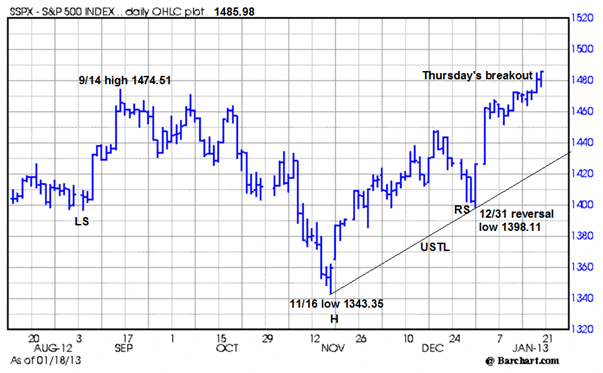
Last Thursday’s breakout to close above the September 14 high of 1474.51 sets up our new upward sloping line USTL and could be important for a potential Head & Shoulders bottom that some analysts are suggesting is active. If so, the left shoulder label is LS, the Head is H, while the right shoulder is RS. Ideally, the USTL should have more than two points and we suspect before the trend is completed more support points will be added and we are expecting to see more than 1500 before it retests the USTL.