
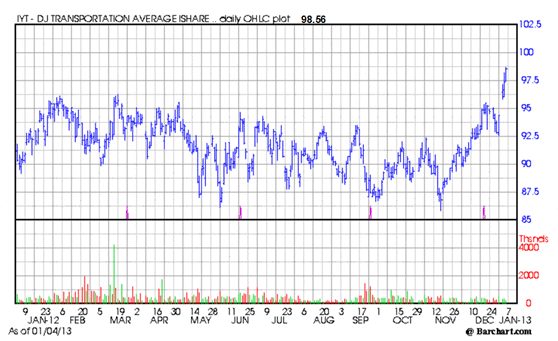
Understandably the markets often give conflicting signals, some bullish, some bearish, but that was not the case for shortened last week as the markets discounted improving economic conditions and a somewhat less uncertain fiscal environment in Washington DC. The change was most noticeable in the economically important transportation sector as the iShares Dow Jones Transportation Average Index (IYT) broke out to the upside, rates on the 10-Year Treasury Note increased and gold staggered.
Market Review
S&P 500 Index (SPX)
While a potential rising wedge from the November 16 low was in the works, the December 31 upside reversal on large volume ended the minor decline. Then the 36.23-point advance on January 2, again on significant volume sealed the deal. Now the objective is to close above the September 14 high of 1474.51 to confirm the change of trend, which seems likely since both the IWM and the IYT have already broken out to the upside.
S&P 500 Index Implied Volatility (IVXM)
For the week, the Implied Volatility Index Mean declined from 19.90 to 12.06, while the CBOE Volatility Index? (VIX) declined from 22.72 to 13.83.
The table below shows the VIX cash compared to the next two futures contracts as well as our calculation of Larry McMillan’s day-weighted average between the first and second months.

The day weighting applies 35% to January and 65% to February for an average premium of 17.07% shown above. Our alternative volume weighting between January and February is 15.20%. For the first time in many weeks, the premiums over the cash VIX now appear to be back into their previously considered normal ranges.
iPath S&P 500 VIX Short Term Futures ETN (VXX)
From an opening high of 36.79 on December 31, Friday’s closes represents a 25% decline in four trading days. The five-day average volume was 36.9 million shares with 59 million on December 31, the big down day.
VelocityShares Daily Inverse VIX Short Term ETN (XIV)
The 5-day average volume for the inverse was 23.9 million shares with the largest volume of 37.8 million occurring on January 2.
Increasing volume in both the long VXX and the short XIV appears to be important influences determining the VIX futures premium. The long VXX trades between 1.5 and 2.5 times as many contracts as the short XIV, but increasing relative XIV volume reduces the VIX premium as more futures contract are sold. The 5-day average was 1.55, with Friday’s ratio at 1.84. When the term structure is in contango, or it slopes upward over time, the advantage goes to a long XIV position since it represents a short futures position and VXX continuously sells the near term contract and buys the next longer term at a higher price.
Fridays VIX futures volume was 140, 344 contracts compared to 139,438 the previous Friday while the open interest increased from 319,922 contracts to 371,670.
VIX Options
With a current 30-day Historical Volatility of 118.62 and 74.65 using Parkinson’s range method, the table below shows the Implied Volatility (IV) of the at-the-money VIX calls and puts using the futures prices based upon Friday’s closing option mid prices along with their respective month’s futures prices, since the options are priced from the tradable futures.

?Using the IV Index Mean of 55.63 down from 106.40 the previous Friday, the IV/HV ratio is .47, using the range method for Historical Volatility the ratio is .75 while the VIX put-call ratio at .55 is on the bullish side for VIX, but less so for the SPX since they move in opposite directions. Friday’s options volume was 673,295 contracts compared to the 5-day average of 800,530.
The equity only put call ratio was .64 making the spread between the SPX put call ratio and the VIX put call ratio .09. A wider spread is bullish since means the VIX put call ratio relative to the SPX call ratio is lower.
iShares Barclays 7-10 Year Treasury (IEF)
There has been a significant three-day note price decline as the 10-year rates increased to close at 1.91, the highest since early August. However to turn the trend higher rates will need to close above the March 2012 high at 2.39. While this rally could be an opportunity to sell, it could also be the start of a new uptrend in interest rates.
iShares Dow Jones Transportation Average Index (IYT)
In addition to being an important Dow Theory indicator the transports deserve close attention as a leading indicator especially when they breakout to the upside. Trucks move goods before retail sales occur while railroads move materials and finished goods months before consumer sales. From this perspective, the breakout above 96, the entire 2012 range, is significant as shown in the chart.
NYSE McClellan Summation Index
For the short week, the advance was 131.97 points, and moving higher once again, but lagging NYSE Composite Index in high territory creating a divergence that deserves some consideration. Ideally, they should both be at new highs.
SPDR Gold Shares (GLD)
The seasonal yearend advance did not materialize as expected and the suggestions made in Digest Issue 45 and Digest Issue 47 were closed out according to their trade plans on the decline below 162.30 that occurred on December 18.
Without seasonal help or fiscal cliff chatter and with suggestions of a stronger dollar and higher interest rates gold may not yet have seen the bottom for this decline.