
Since the current S&P 500 Index (SPX), uptrend appears stalled or perhaps in the process of forming another symmetrical triangle continuation pattern, the options implied volatility has started increasing although from a low level. If the uptrend resumes we can expect to see lower implied volatility once again, in the meanwhile perhaps we should consider some ideas in the event implied volatility continues increasing.
Strategy
S&P 500 Index (SPX)
Either another symmetrical triangle continuation pattern is underway like to one that started on February 21 or a larger correction that could test the current 1530.94 support has begun as volume increased from the prior week. Although the VIX closed the week higher, both the VIX futures premium and the Skew Index declined suggesting less hedging activity.
The table below shows the VIX cash compared to the next two futures contracts as well as our calculation of Larry McMillan’s day-weighted average between the first and second months.

The day weighting applies 85% to April and 15% to May for an average premium of 10.35% shown above. Our alternative volume weighting between April and May is 12.29% in the middle of the normal range on lower volume and open interest after the March future contract expired.
iPath S&P 500 VIX Short Term Futures ETN (VXX)
The five-day average volume was 70.3 million up substantially from 48 million shares the week before.
VelocityShares Daily Inverse VIX Short Term ETN (XIV)
The 5-day average volume for the inverse was 19 million shares compared to 15.9 million the week before making the VXX/XIV volume ratio 3.69.
When the term structure is in contango, or it slopes upward over time, the advantage goes to a long XIV position since it represents a short futures position and VXX continuously sells the near term contract and buys the next longer term contract at a higher price. The current spread between April and May is -1.23, while the May – June spread is -.92.
In the event the trading range expands or the market continues lower, increasing implied volatility is likely. If so, consider this idea.
?
Dan Sheridan’s Increasing Volatility Idea
Income Trade for a low volatility environment
For those over 45 who can remember the battle cry from Clara Peller, the little old lady in the Wendy’s commercial “Where’s the Beef”? We are hearing similar battle cries today in the options world. Credit spread traders, covered writers, cash secured put sellers, Iron Condor and butterfly traders all across the country are yelling “Where’s the time premium”? Of course they are referring to the lack of time premium received when doing strategies like the ones mentioned above. What?s the solution? Do we find another hobby while we wait for premium levels to increase? Of course not, there are strategies to employ in low time premium environments that benefit when volatilities go up. Really, your not joking? Really! With the VIX at 13.57 and RVX at 16.97 option volatilities are near 5 year lows. If you are willing to expand your option knowledge you can add new strategies to your repertoire. Here is a long vega strategy for monthly income that benefits when time premiums expands, when option volatilities are very cheap, when there is much more room for them to go up than to go down.
SPDR S&P 500 (SPY) Double Calendar
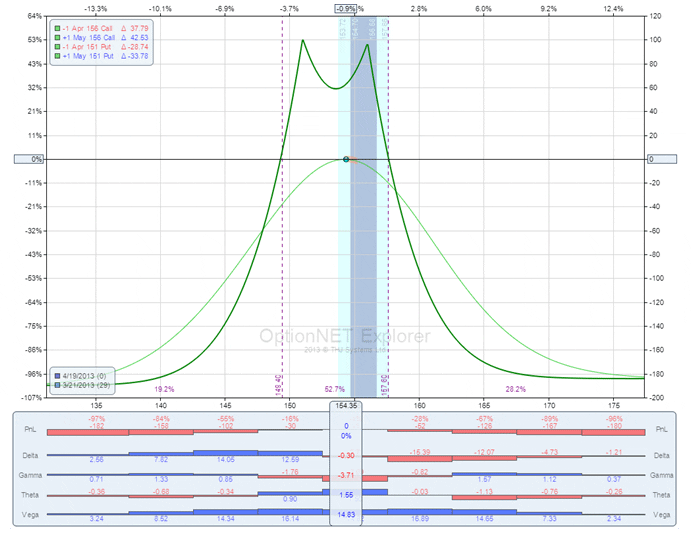
Part one, buy 1 May 156 call and sell 1 April 156 call.
?
Part two, buy 1 May 151 put and sell 1 April 151 put.

Total debit 1.42 (142).
Implied volatility levels are extremely low and this trade would benefit if implied volatility levels increased. When would I do this type of trade? Double Calendars can be particularly attractive when Implied volatility levels are cheap and you think they could increase a bit. How do price moves affect this strategy? As the price moves beyond your short strikes past your expiration breakeven points, you will need to take off or adjust the position. If the price stays between your short strikes, you will usually be in good shape and the trade will usually be profitable. What can I do if the price moves too far? One quick idea is to take off the calendar trade farthest away. What do you mean? If SPY in this example goes up to say 157, one point past our short strike, I would take off the put spread at the 151 strike. If SPY is between 152 and 156 by Thursday March 28 , and Implied volatility increases just 1 point, this trade would be up approximately 10% before commissions. Keep an eye on this! Here is the graph.
?
Long vega trades can be used for monthly income. The challenge is to put these types of trades on for 2-3 months on paper to get the feel of them. I will make you a guarantee. This won’t make sense unless you practice! Keep working on the craft!