
Last week we raised the possibility of big cap Apple Inc. (AAPL) holding support at 600 thereby helping to support the S&P 500 Index (SPX) at 1400. As Apple headed lower Friday, dashing this scenario possibility, it is time again to consider adding some hedges.
After a brief strategy comment, we have a straddle progress report for Whole Foods (WFM) followed by an update for a previous United States Oil (USO) put spread and a new put spread idea for the Healthcare Select Sector SPDR (XLV).
?
Strategy
S&P 500 Index (SPX)
Although SPX had already closed below the upward sloping trendline (USTL) that began with the June 4 low at 1266.74 we were looking for Apple Inc. (AAPL)? to hold support at 600. As Apple broke below support and since the S&P 500 Index is capitalization weighted with Apple having the most influence, as Apple goes so goes the S&P 500 Index. This is particularly noteworthy since there does not appear to be any support for Apple before 525 as the momentum traders seem to be ditching it. Now we have to wait and see where the value buyers will step in and do some buying.
In addition, a newly identified potential SPX Head & Shoulders Top becomes active on a close below the 1400 support level. Replacing our previous Double Top downside-measuring objective at 1388 explained last week, the new Head & Shoulders Top objective is down about 1327, if set off.
Of further concern, Larry McMillan notes that the equity put call ratio gave a sell signal about a month ago when SPX made the second test of the high that formed the potential double top. Larry says the trend of the ratios is rising and any further continuation is bearish. By creating spread between the rising equity only put call ratio and the declining VIX put call ratio we have another market measure. With the equity put call ratio at .77 and the VIV put call ratio at .27, the spread is .50, compared to .21 last week and -.20 on September 14, as the SPX made its most recent high at 1465.77.
While unclear if the Currency Shares Euro Trust (FXE) down 1.10, was the cause or result of Apple’s breakdown, the decline below the recent 128-131 range triggered another “risk off” selling event obvious in crude oil, gold and other commodities.
S&P 500 Index Implied Volatility (IVXM)
At the end of last week, the Implied Volatility Index Mean increased from 15.08 to 15.36, while the CBOE Volatility Index? (VIX) decreased from 17.81 to 17.59.
The table below shows the VIX cash compared to the next two futures contracts as well as our calculation of Larry McMillan’s day-weighted average between the first and second months.

The day weighting applied 48% to November and 52% to December resulting in an average premium of .63 or 3.56% shown above. Our alternative volume weighting between November and December is once again almost the same at 3.12%. Last week the day-weighted premium was 3.66%, while the volume weighted was 3.60%. The low premium levels seem to be in conflict with the more cautious developing technical outlook. The futures volume increased to 142, 901 contracts compared to the week before at 96,072 contracts as the open interest increased from 361,488 contracts to 377,862.
Although not reflected in the VIX futures premiums, last week’s technical developments were enough for us to conclude the time has come to add some hedging and we begin with a crude oil update after this straddle progress report.
Work in Progress
A few weeks ago we featured Volatility Kings along with three straddle ideas for upcoming earnings reports based on the premise that implied volatility will rise enough going into the earnings report to offset the time decay of the long options position. We quickly realized using longer dated options only increases time decay exposure without increasing implied volatility that only really occurs in the nearest expiration month before the reporting date. Accordingly, we closed the January positions for both Under Armor (UA) and Avon Products (AVP).
We retained the November 100 straddle for Whole Foods Market (WFM).
We originally booked the long November 100 call and put for 8.63. On Friday, the mark-to-market value was 8.15 for a .48 loss, although the implied volatility had risen from 28 to 50 as originally planned, but not enough to offset the time decay loss on the long options. Now unless there is an implied volatility surge on Monday and Tuesday before reporting Wednesday, the position is not likely to work out well. According to the plan, we will close it Tuesday and calculate the result.
Update
United States Oil (USO) ?
We suggested a put spread four weeks ago and since then USO has made two jerking steps lower toward our 30 objective, corresponding to about 80 for WTI, basis December futures. Any further dollar strength and corresponding euro weakness will further support a continuation of the decline toward the objective. The original position was long a November 34 put and short a November 30 put creating a November put spread for a debit of 1.19. The mark-to-market value is 2.43 for gain of 1.24, or 104% in about six weeks. Since the November expiration is fast approaching, we want to extend the position by adding another in December.
Here is the current options data.
The current Historical Volatility is 26.34 and 18.87 using the Parkinson’s range method, with an Implied Volatility Index Mean of 30.70, up from 30.67 last week. The IV/HV ratio is 1.17 and 1.63 using the range method to calculate the HV. Friday’s put-call ratio at 1.55 was bearish while the volume was 85,829 contracts traded compared to the 5-day average volume of 70,220. Consider adding this December put spread idea.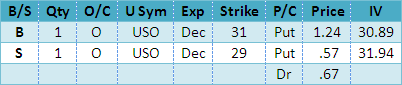
At 34% of the distance between the strike prices, it has a reasonable risk to reward ratio, but not much volatility edge. Use a close back above the top of the recent gap at 33 as the SU (stop/unwind).
Call Put Skew
Health Care Select Sector SPDR (XLV)
With a 16.8% gain from the June 4 low to the October 17 high, there was a noticeable skew between the implied volatility of the calls at 14.45 and puts at 16.07 on Friday ranking it number one in the category. With some investigation, we found the skew resulted from the sale of 55K November 42 calls depressing the call-implied volatility. While many other sectors are also good put spread candidates we decided this one was a good as any and may even contain some election speculation that may be unwinding.
The current Historical Volatility is 11.54 and 9.71 using the Parkinson’s range method, with an Implied Volatility Index Mean of 15.26, up from 14.94 last week. The IV/HV ratio is 1.32 and 1.58 using the range method to calculate the HV. Friday’s low put-call ratio at .20, normally be considered very bullish, but since it was almost entirely the result of an out-of-the-money call sale this is not the case. The volume was 64,616 contracts traded compared to the 5-day average volume of 23,820. Consider this December put spread idea.
?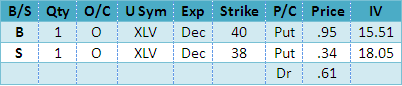
At 31% of the distance between the strike prices, it has a good implied volatility edge making it a low cost hedge against further decline. Use a close back above 41 as the SU (stop/unwind).
Both of the suggestions above use the closing middle price between the Friday bid and ask. Monday, the option prices will be somewhat different due to the time decay over the weekend and any price change.
?
Summary
After Apple’s breakdown, the market outlook for the rest of the year is decidedly less favorable. While the S&P 500 Index is above the 1400 support level, a potential Head & Shoulder Top implies much lower levels if triggered. Based on this, some additional hedging strategies now seem prudent.