
This is probably what many traders trying to pick a top in the Lumber market are saying right now. While I don?t have a problem with traders who think they can pick tops and bottoms in the markets (we do need these losing traders to cover their positions and help our trend continue), I feel that if they would just add an additional enhancer or two to their arsenal of trading tools they would increase their odds of success.
Many of you will never trade the Lumber market, me included due to the illiquid volume, the Limit up and down days and the contract size of approximately $40,000.? But does that mean we should not track the Lumber market for clues as to how the economy is doing?? Absolutely not!? The Lumber and Copper market both timed the 2009 low in the Stock market perfectly.? Both of the Commodity contracts bottomed in price around January of 2009.? Our Stock market went down into March of 2009. I remember the news at the time ?there will never be another new home built in America because we have too many homes for sale.? ?Everybody knows how bearish the news is at market bottoms and how bullish it is at market tops, this time was no different.? What amazed me was how these two Commodities had such a strong rally in place and yet the media was still saying the world was coming to an end.? We all know that Joe retail was not buying one and two contracts of these Commodities and making price rally this strongly.? These markets were in the hands of the real professional traders, the Commercials.? Each home built has approximately 400 pounds of Copper and who knows how many 2?4 studs used for building walls.? These Commercial entities saw value in very underpriced products and started accumulating them.
Looking at Figure 1 we can see a long term chart of Lumber going back to 1973.? These charts are compliments of Moore Research Center Inc.? They are provided for free on their website at www.mrci.com
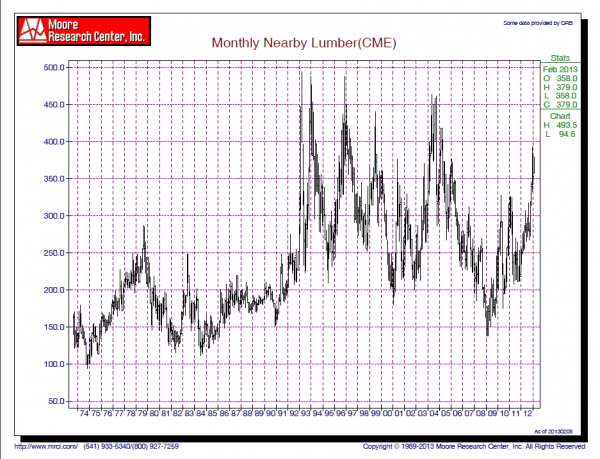
Commodity markets are driven largely by Supply/Demand of the particular Commodity.? If there is too much product the price will decline, if there is not enough product price will rise.? I like to look at these long term charts and find floor and ceiling prices that can be clues as to when a market might really be ready to make a top or a bottom.? Notice that Lumber going back to 1973 has a floor in its price at approximately $100 to $150.? Notice how the selloff in Lumber back in 2009 terminated near the historical floor prices of Lumber.? There is also a ceiling in price of about $425 to $475.? The rally in Lumber currently has Lumber trading up near $400.? The media is talking about how it could go much higher.? Imagine that, the media waited until the Lumber market traded up to almost 40 year highs in price before getting bullish on the market.? While this hype might make the talking heads on television look brilliant we as traders know that this is a red flag when the media is talking up a market.
When a market trades near extreme highs in a Commodity this will bring out the Commercial interest known as producers.? Producers will sell as many Futures contracts as they can at these levels trying to lock in the high price.? They are smart enough to know that these prices are rarely seen and will take advantage of hedging their Lumber products they will want to sell at a later date.? Once they sell these Futures contracts at these higher prices they are protected against lower prices into the future.? Think of their Hedge as an insurance policy against lower prices in the future.
Another event which is coming into play is Seasonality.? Moore Research Center (MRCI) has done research on the Lumber market going back 15 years.? They have found that the Lumber market has closed lower on February 19th than on February 9th 13 of the last 15 years.? Typically the Lumber market makes its high prices between February and April each year.? The Seasonal lows are usually seen around September and October.? According to MRCI Lumber prices rise into the winter with log decks low, weather slowing timber harvest and large developer/wholesalers building inventory for next construction season.? The February ? April peak precedes consumption.? Demand declines sharply after a final spurt of buying in early September, but log decks are depleted.? A quote to remember Lumber Seasonals ? ?Long by Halloween, out by Valentine?s Day.?
Notice ? These are not intended to be trade recommendations and should only be considered for educational purposes only.
Figure 2 will show the current price action for Lumber.? The yellow vertical band is the optimal dates to look for Lumber to peak and begin a retracement based on the historical patterns of Lumber.
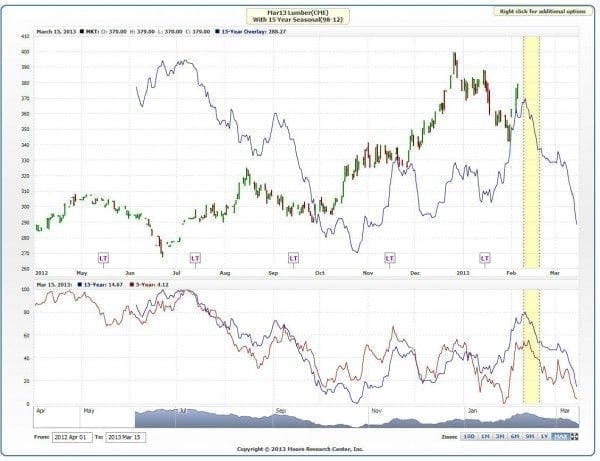
As I mentioned earlier you do not need to trade Lumber to find this information useful.? The reason I am explaining these patterns to you is that many of you trade ETF?s or Stocks that are related to the home building business.? By following the Lumber market you can get a better feel for if the home builders are going to continue their strong price moves to the upside.? If you are already long the home builders then if any of these situations arise maybe you might want to tighten up your protective stops.
I presented to you a scenario of very high prices for the Lumber market and a Seasonal sell pattern facing the Lumber market.? While this might work there is always a chance that prices can go higher.? And this brings me to another point.? Typically when prices completely ignore their Seasonal tendencies (in this case go down) they have very strong moves in the opposite direction.? Even though price is very high there is plenty of room if the Seasonal pattern fails miserably to capitalize on higher prices.? Just keep in mind that once Lumber is in the $425 to $450 area there will be very strong Commercial selling.
I find the addition of Seasonal patterns and long term historical charts are very helpful when trading Commodity Futures contracts.? When using this information to enhance our trading levels that we create it might help give you more confidence in your trade.? MRCI still offers their special free 2 week trial to OTA graduates. Contact Melissa Moore at melissa@mrci.com for more information.
?It?s fine to celebrate success, but it is more important to heed the lessons of failure.?? Bill Gates
– Don Dawson