
This is a proprietary realized volatility rating created by Capital Market Laboratories (CMLviz) based on a large number of data interactions for Silicon Laboratories Inc (NASDAQ:SLAB).
We examine the little used gem of daily stock volatility over a 20-day and 30-day trading period, as well as comparisons to the last year and the actual stock returns over the last three- and six-months and the S&P 500 and Nasdaq 100 indices.
As a heads up, in the “Why This Matters” section at the end of this article on Silicon Laboratories Inc (NASDAQ:SLAB) , we’re going to take a step back and show really clearly that there is actually a lot less “luck” in successful option trading than most people are aware of. This idea of an “option trading expert” is vastly over complicated so those with the information advantage can continue to profit at the expense of the rest.
But before that, let’s turn back to SLAB. This is a four step process for computing the realized volatility risk. Here we go.
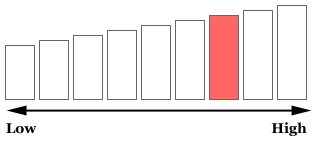
Rating
Realized volatility using proprietary measures has hit an elevated level.
Note
Even though Silicon Laboratories Inc generates substantial revenue and is a mid cap, technology companies in general have higher stock volatility than the rest of the market. Here is a rolling annual volatility chart of the biotech index (IBB) versus the Nasdaq 100 and the S&P 500. Note how elevated the technology sector volatility is (the yellow curve) relative to the S&P 500.

Let’s take a deep dive into some institutional level volatility measures for Silicon Laboratories Inc (NASDAQ:SLAB) .
SLAB is up +14.1% over the last three months and up +35.7% over the last six months. The stock price is up +96.5% over the last year. The current stock price is $72.6.

The one-year stock return does not impact the volatility rating since we are looking at a shorter time horizon. However, the rating does examine the 3-month returns and the absolute difference between the 3-month and 6-month returns.
The 3-month stock return of +14.1% has a small impact on the realized volatility rating for SLAB.
The noteworthy difference between the 3-month and 6-month stock returns has a meaningful impact on the realized volatility rating for SLAB.
The HV30? takes the stock’s day to day historical volatility over the last 30-days and then annualizes it. The HV20 looks back over just 20-days — a shorter time period. Here is the breakdown for Silicon Laboratories Inc (NASDAQ:SLAB) and how the day-by-day realized historical volatilities have impacted the rating:
The HV20 of 35.7% is in the middle ground, neither elevated nor depressed, so in this case the raw HV20 number has no impact on SLAB’s volatility rating.
SLAB Step 3: Silicon Laboratories Inc HV20 Compared to Indices
The HV20 for SLAB is substantially larger than that for both the S&P 500 and the NASDAQ 100 which raises the volatility rating.
The HV20 for SLAB is substantially larger than that for the Technology ETF (XLK) which raises the volatility rating.
Here is summary data in tabular and chart format.

SLAB Step 4: Daily Volatility Percentiles and Highs
We also examine the annual high of the HV30 in our rating but in this case the 52 week high in HV30 for SLAB is 39.3%, which is not enough to impact the realized volatility rating.
Here is summary data in tabular and chart format.

Final Realized Volatility Percentile Level: SLAB
The final evolution of the volatility rating for Silicon Laboratories Inc is a comparison of the HV30 value relative to its past, which is neatly summarized in the percentile — a scoring mechanism that goes from a low of 1 to a high of 100.
The HV30 percentile for Silicon Laboratories Inc is 62%, which means the stock has seen elevated volatile price movement relative to its own past and that has a small impact on the realized volatility rating.

There’s actually a lot less ‘luck’ and a lot more planning in successful option trading than many people know. But it’s not about trying to guess which stocks will go up or down. What the back-tester empowers you to do is find calm, low-stress stocks and ETFs and then identify the option strategies that have created a high percentage of winning trades, gaining profitability slowly, while managing earnings.