
Today’s Spotlight Market
Even with the Reserve Bank of Australia (RBA) lowering interest to a record low of 1.5%, the Australian Dollar rose vs. the U.S. Dollar as yields in the ?land down-under? still look attractive to investors experiencing negative yields in Europe and Japan. In addition, traders are starting to believe that the RBA may be nearly done lowering rates as its fights to avoid the impacts of deflation that has plagued nations such as Japan for years. While economists are starting to wonder how effective accommodative monetary policies from the major Central Banks have been in fighting deflation but at least the RBA still has some room to maneuver if necessary without having to resort to the recent ?experiment? of negative rates that is becoming all too commonplace of late.? ?
Fundamentals
The Japanese Yen has been a strong performer for nearly all of 2016, much to the dismay of both political and Central Bank officials, who have been attempting to weaken the value of the nation?s currency in the hopes of stoking inflation. Traders have been buyers of Yen versus both the U.S. Dollar and the Euro as continued hesitation by the Federal Reserve to raise U.S. interest rates and the various financial issues plaguing the European Union have forced the hand of investors to move assets to Japan in the guise of a ?safe haven?. Even when the Bank of Japan (BOJ) takes ?action? to supposedly help stimulate its economic growth, traders have shrugged off any action as not being aggressive enough to satisfy market participants. There is talk that the BOJ will have to finally resort to so called ?helicopter money? where the Central Bank provides cash directly to the populous in the hopes of stimulating consumer demand. While the concept of ?helicopter money? was made famous by a paper written by the Nobel Prize winning economist Milton Friedman, to show how aggressive monetary policies can help to influence inflation levels, I don?t think that Doctor Freidman ever dreamt that such a concept would ever been a possibility for a major Central Bank to even consider but then again we now live in a world where negative interest rate policies are becoming the norm in many parts of the world. While there appears little in the way of economic data that may halt the rise of the value of the Yen in the near term, traders should remember that the Bank of Japan has in the recent past (2011) intervened in the currency market to weaken the value of the Yen. While the value of the Yen is still well below the price levels seen in 2011 that forced the BOJ intervention, trend following traders should keep this possibility in the back of their minds especially in an environment where Central Banks are willing to ?experiment? with unconventional tools to try to spur economic growth.??? ?
Technical Notes? -? View Today’s Chart
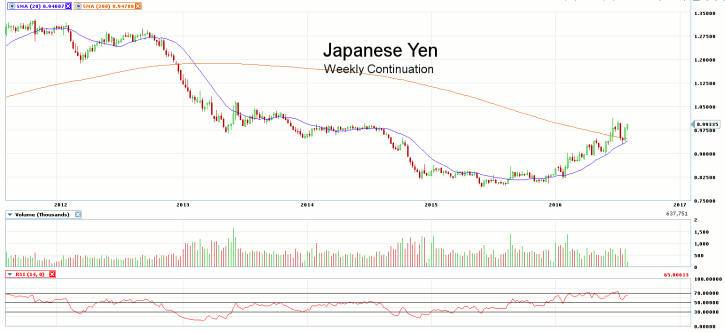
Looking at the weekly continuation chart for the Japanese Yen futures, we notice prices is a sustained uptrend following what now appears to be a ?rounded bottom? chart formation that developed throughout all of 2015. Prices have now decisively moved above previous resistance at 0.9900 and appear set for a test of the 1.0500 price level. The 20-week moving average appears ready to cross above the 200-week moving average, which is viewed by many trend-following systems as a bullish signal. The 14-week relative strength index (RSI) is strong but remains just below overbought levels with a current reading of 65.00. The 2016 high of 1.0131 is seen as the next resistance area for the lead month futures, with support found near the 0.8950 price level.?
 ————————————————————————————————-
optionsXpress, Inc. makes no recommendations on investments and does not provide financial, tax or legal advice. Content and tools are provided for educational and informational purposes only. Online trading has inherent risks due to system response and access times may vary due to market conditions, system performance and other factors. An investor should understand these and additional risks before trading. Options and Futures involve substantial risk and are not suitable for all investors.