
Today’s Spotlight Market
The market price volatility in the Brent vs. WTI Crude Oil spread has been relatively muted so far in 2016, especially compared to the wild price swings we have seen the past several years. We are starting to see Brent futures prices slowly increasing their premium to the U.S. ?benchmark? WTI contract. The lead month October Brent vs. WTI spread has recently traded near its highest levels since the start of the year, with the Oct Brent now trading at a premium of about $1.43 above the October WTI contract. To put this in some prospective, this spread was trading at over $3 Brent discount in January. Some traders will be keeping a close watch on storage capacity levels in Cushing, Oklahoma, which is the delivery point for the NYMEX WTI contract. Should storage levels at Cushing begin to tighten, we could see the Brent premium continue to widen, as the market needs to ?encourage? the drawdown of supplies from Cushing to avoid storage issues as we move into the 4th quarter of the year.
Fundamentals
The U.S. remains well supplied in both Crude Oil and its products, with current inventories running well above the 5-year averages for this time of year. On Wednesday, the Energy Information Administration (EIA) released its weekly update on U.S. petroleum inventories and reported that as of the week ending July 22, U.S. Crude Oil inventories rose by 1.671 million barrels to stand at 521.133 million barrels. This is well above the 5-year average of just over 384 million barrels. While this data has added to the overall bearish tone of the energy markets, it was the data on U.S. Gasoline stocks that really may be setting the negative tone for energy prices.
The EIA reported that U.S. Gasoline supplies rose by 452,000 last week, to bring inventories to 241.452 million barrels. This year?s totals are well above the 5-year average of just over 216 million barrels. We must remember that we are in the heart of the summer driving season when families take their summer vacations prior to the start of the school year. So the fact that Gasoline inventories continue to increase remains troubling to bullish traders looking for a bounce in prices in a market that on the surface appears to have become oversold.
Refiners have been taking advantage of ?cheap? Crude Oil to increase refining rates and produce more Gasoline and Distillates such as Diesel fuel. However, while U.S. Gasoline demand is robust, it has not increased enough to overcome the large supplies of Gasoline being produced. so we are seeing lower Gasoline prices this summer. While refinery profit margins have started to contract, one has to wonder whether refineries will curtail Gasoline production enough to help alleviate the current surplus, especially once the peak summer driving season ends as the Labor Day holiday approaches. If not, we could see Gasoline prices once again fall below $2 per gallon when refiners can switch production to the cheaper winter blends of Gasoline in the 4th quarter of this year??? ?
Technical Notes – View Today’s Chart
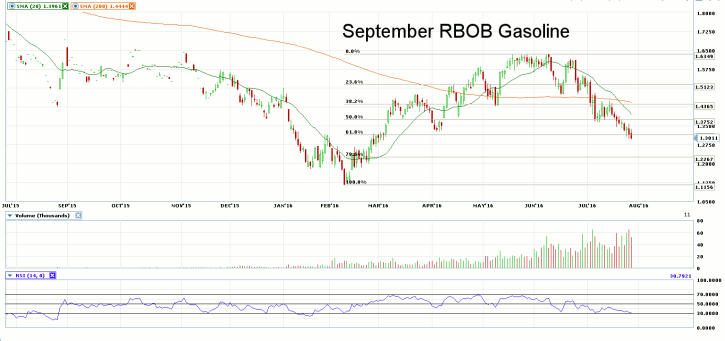
Looking at the daily chart for the September RBOB Gasoline futures, we notice prices in a sustained downtrend since the middle of June following an unsuccessful attempt to break above resistance at 1.6500. The downtrend gained some technical momentum once the 20-day moving average crossed below the 200-day average. The 14-day RSI is weak but has not yet crossed into oversold territory, with a current reading of 30.79. For those traders who utilize Fibonacci retracement levels as a guide to support and resistance areas, we do note that prices are currently hovering near the 61.8% retracement from the February 2016 low to the June 2016 high. 1.2655 is seen as near-term chart support for the September contract, with resistance found at 1.4484.
 ———————————————————————————————
optionsXpress, Inc. makes no recommendations on investments and does not provide financial, tax or legal advice. Content and tools are provided for educational and informational purposes only. Online trading has inherent risks due to system response and access times may vary due to market conditions, system performance and other factors. An investor should understand these and additional risks before trading. Options and Futures involve substantial risk and are not suitable for all investors.