
Paraphrasing Mike Tyson: Everybody?s got a plan ?till they get punched in mouth.
Like many others who found themselves positioned on the wrong side of the historic Brexit vote, our plan was to update our quarterly Volatility Kings list this week. However, the unexpected does have a way of interfering with the best of plans.
Following updated S&P 500 Index and implied volatility charts, we offer some strategy thoughts for the next few weeks concluding with a new hedge idea for ProShares UltraShort S&P 500 (SDS)
S&P 500 Index (SPX) closed down 33.52 points or -1.64 for the week with a 76.02-point declineFriday, closing once again below the 50-day moving average now 2,079.86 and creating the set up for another potential Head & Shoulder Top shown below.
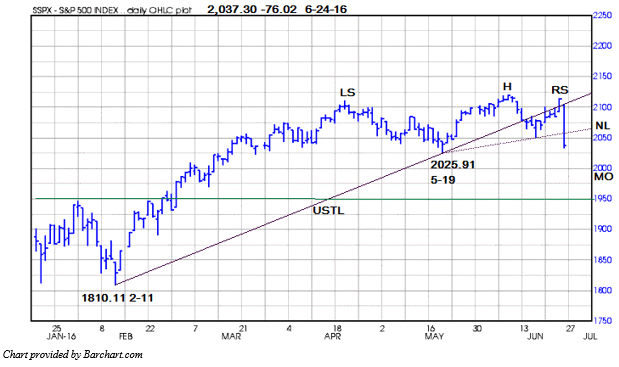
Although below the upward sloping trendline, USTL notice how well prices tracked the slope and then broke out and closed back above USTL Thursday before suddenly changing direction Friday to close below the neckline of the irregular Head & Shoulders Top, from a symmetrical perspective.
The Left Shoulder, LS is the 4-20 high at 2,111.05, Head, H the 6-8 high at 2,120.55 while the Right Shoulder, RS was Thursday?shigh at 2,113.32. Friday?s close was below the Neckline, at 2,062.50. The previous support at 2050 lines up well with the Head and used to calculate the pattern height then subtracted from the Neckline to determine the Measuring Objective, MO at 1992. Although already below the neckline due to the irregular shape of the Right Shoulder, the label ?potential? remains appropriate.
The two important levels to watch this week are previous support at 2050 that defeated the last potential Head & Shoulder Top?and the 5-19 low at 2025.91. After the sudden decline?Friday, short covering may push it back toward 2050, now resistance. If so, then 2025.19 will be the next key level. After that the measuring objective at 1992 and then support at 1950, see the green support line above.
CBOE Volatility Index?(VIX) was up 6.35 for the week after advancing 8.51 Friday to close just below the high for the day. Based on real-time prices of options on the S&P 500? Index, VIX reflects investors’ consensus view of future (30-day) expected stock market volatility.
The table below shows the VIX cash compared to the next two futures contracts as well as our calculation of Larry McMillan?s day-weighted average between the first and second months.

With 17 trading days until the July monthly expiration, the day weighting applied 68% to July and 32% to August for a -12.72% premium shown above. Our alternative volume-weighted average between July and August regularly found in the Options Data Analysis section on our homepage was almost the same at -12.76%.
While day-to-day VIX changes offer little forecasting insight following the VIX futures premium helps since it measures expectations of tactical professional traders and money managers using VIX futures and options for hedging long portfolio risk.
The premium measures the amount the futures currently trade above or below the cash VIX, (contango or backwardation) until front month future converges with the VIX at expiration. Depending on the time to expiration, premiums for normal term structures during uptrends are 10% to 20% and decline when the VIX advances faster than the nearest future as the market declines and/or the futures decline as the front month expiration approaches. Premiums less than 10% suggest caution and negative premiums indicate oversold conditions when the VIX is higher than the futures and are usually associated with reversals although previously have remained negative for two weeks or more.
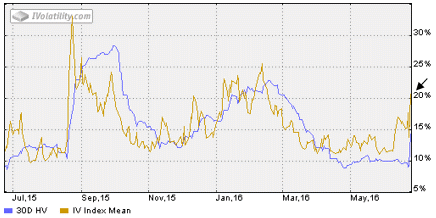
From an implied volatility perspective, the advance has yet to reach previous levels that occurred in February or last August suggesting it will likely continue higher. See the SPX implied volatility chart.
Hedge with Edge
ProShares UltraShort S&P 500 (SDS) gained .54 points or +2.93% for the week after trading as low as 17.70 Thursday when the market was anticipating the opposite Brexit result and SPX closed back above the upward sloping trendline shown in the chart above.
The current Historical Volatility is 27.88 and 17.01 using the Parkinson’s range method, with anImplied Volatility Index Mean of 43.23 up from 33.23 the week before. The 52-week high was 74.37 on August 24, 2015 while the low was 20.96 on July 22, 2015.
While implied volatility usually rises as the underlying declines, for this ETF it?s the opposite, since implied volatility advances along with SDS. Thus, positions with an extra long option, like a ratio spread would add implied volatility edge. However, for the sake of simplicity the idea below is a less complicated call spread, but with a clear implied volatility edge meaning the call sold is relatively more expensive in implied volatility terms than the long call. Compare the implied volatility of the long call at 44.39 to the short call at 59.77. The implied volatility/historical volatility ratio using the range method is 2.54 so option prices are expensive relative to the recent movement of the ETF implying high expectations for a large move.
Friday?s option volume was 52,056 contracts with the 5-day average of 22,960 contracts with favorable bid/ask spreads.

Using the ask price for the buy and mid for the sell the call spread debit would be .56 about 19% of the distance between the strike prices with a good implied volatility edge. Use a close back below the 18 as the SU (stop/unwind).
The spread suggestion above is based on the ask price for the buy and middle price for the sell presuming some price improvement is possible. Monday?s option prices will be somewhat different due to the time decay over the weekend and any price change.
Summary
After getting Brexit wrong, the S&P 500 Index along with most of the markets scrambled to adjust positions back to levels that existed before anticipating success for the ?remain? crowd. How much further they will go is uncertain however, the S&P 500 Index closed below the upward sloping trendline and the 50-day moving average and option implied volatility will likely increase into a new higher range to reflect uncertainty associated with restructuring news from Britain and the Eurozone.