
Today’s Spotlight Market
As June approaches, we can finally say good bye to ?El Nino,? the weather event triggered by a warming of tropical waters in the Pacific Ocean. Weather forecasters report that Pacific waters are starting to cool, which is signaling the end to one of the strongest El Ninos in recorded history. Now analysts are on the watch for the potential appearance of El Nino?s sibling ?La Nina,? which is an abnormal cooling of Pacific waters that has in the past caused weather concerns including drought conditions for the U.S. grain producing regions. ?
Fundamentals
It appears that trend-following commodity funds are leading the Corn and Soybean markets higher of late, with mixed fundamental data becoming an afterthought. Front-month July Corn continues to make a run at the ?spike? high of 407.25, and front-month July Soybeans have shaken off a recent price correction to move within striking distance of chart resistance at 1091.50. The most recent Commitment of Trader?s report shows that large and small speculative accounts added nearly 34,000 new net-long positions among the entire grain complex, with new long Corn positions accounting for over 21,000 contracts and Soybeans over 7,600 contracts. While technicals appear in control currently, fundamentals are still important, and here the outlook appears a bit cloudy. Crop concerns in Brazil and Argentina have analysts looking for the U.S. to potentially increase its export business. However, much of this will be dependent on the performance of the U.S. Dollar. In addition, it appears that U.S. producers are generally off to a good start with Corn plantings, and recent price gains for Soybeans have traders expecting more acreage to shift to Soybeans this spring than the USDA had originally forecasted. The wildcard for U.S. Corn and Soybean production this season is the weather, and the potential of a La Nina weather event may be influencing a bullish bias to prices in the form of a risk premium in case of weather issues this summer. The National Weather Service in their longer-range outlook has most of the U.S. grain production areas at normal to above-normal temperatures through August, with normal to above-average precipitation. However, should a La Nina event become likely, we may see potential issues with precipitation as we move into late summer, which could provide a difficult finish for this year?s crop and potentially tighter supplies than originally anticipated.
Technical Notes?? -?? View Today’s Chart
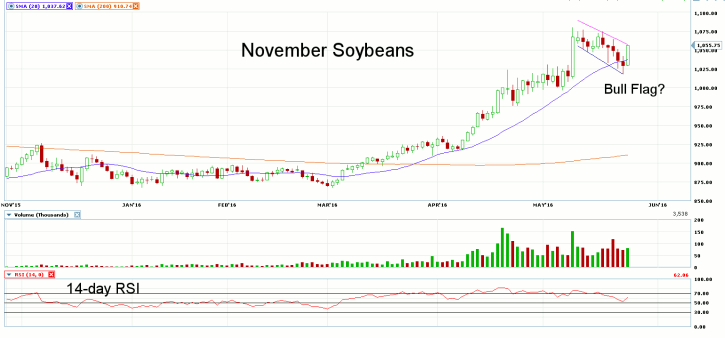
Looking at the daily chart for November Soybeans, we notice what could be a bull flag technical formation being developed. To confirm this chart pattern, we would need to see prices break above the upper trend line and ideally on above average trading volume. Prices have once again moved back above the 20-day moving average following the recent price correction, which could generate additional buying interest by short-term momentum traders. The 14-day RSI has turned upward following a correction from overbought levels, with a current reading of 62.06. Resistance is seen at the May 10 high of 1079.75, with support seen at the recent low of 1018.75 made on May 24.
 —————————————————————————————–
optionsXpress, Inc. makes no recommendations on investments and does not provide financial, tax or legal advice. Content and tools are provided for educational and informational purposes only. Online trading has inherent risks due to system response and access times may vary due to market conditions, system performance and other factors. An investor should understand these and additional risks before trading. Options and Futures involve substantial risk and are not suitable for all investors.