
Markets React to Slow Employment Gains in 2013
Today’s Spotlight Market
Although the U.S. Jobs report for December was viewed as a disappointment by many traders, the employment picture out of Canada was even more dour. In December, Statistics Canada reported 45,900 net-new jobs were lost, which was the largest monthly decline in 9 months. The unemployment rate shot-up to 7.2%, vs. 6.9% in November. For all of 2013, Canadian employment rose by a scant 0.6%, with a total gain of only 102,000 jobs, vs. 310,000 jobs created in 2012.
Fundamentals
The December jobs report was a mix of good news and bad news. First the good news: the unemployment rate fell by a larger than expected 0.3% last month to 6.7%.? Also, the November non-farm payrolls figure was revised upward to 241,000 jobs created, vs. 203,000 jobs that were originally reported.
Now the bad news: job growth in December was less than stellar, with only 74,000 jobs created according to the Labor Department. This was well below the 200,000 plus jobs most economists were expecting, and a complete miss from the 235,000 private sector jobs created from the ADP report that was released on Wednesday.
In addition, that 0.3% decline in the unemployment rate was mainly due to more discouraged job seekers leaving the workforce. The size of the labor force fell to 62.8% in December, which was the lowest reading in 35 years!? For all of 2013, job growth averaged 182,000 jobs per month, which was nearly identical to that for 2012 (183,000 jobs per month). This does put into question the belief that job growth is accelerating.
While the ?poor? payrolls figure may put into question whether the Federal Reserve will continue to slowly ratchet back its Bond purchases in the coming months, it is most likely that the Fed will continue to monitor upcoming economic data and will continue to taper its purchases, although at a more gradual rate, unless we see sustained evidence that the economic recovery is faltering.
Market reaction to the jobs report was mixed, with strong gains seen in the U.S. Treasury complex, as well as in Gold futures.? But the U.S. Dollar weakened against most of its major peers with the exception of the Canadian Dollar, as our neighbors to the north reported an even more dour jobs report for December (see today?s spotlight market).? Equity index futures were little changed as the rampant bull market for U.S. stocks continues to trudge along. ?
Technical Notes? -? View Today’s Chart
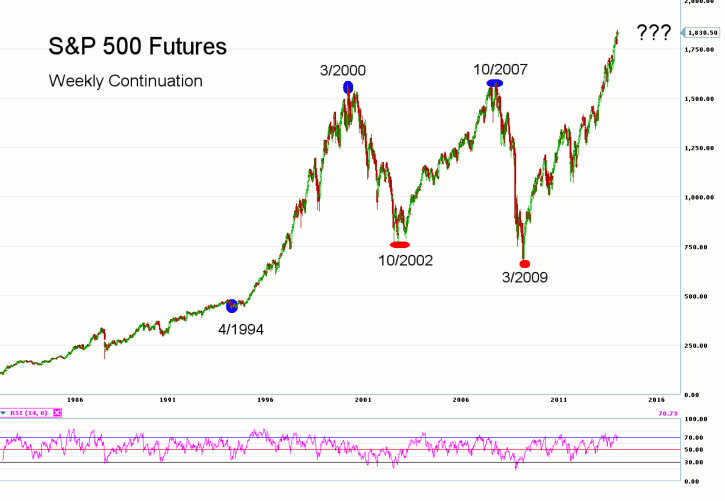
Taking a look at the weekly continuation chart for the S&P 500 futures, we notice that the recent leg in the bull market for equities, which begin at the March 2009 lows, has taken the index value up about 1150 points in nearly 5 year?s time.? This is nearly the same price movement as that seen starting back in March 1994 to the March 2000 highs. We remember that after the market ?peaked? in 2000, the S&P 500 fell by over 750 points in only 30 month?s time.? We saw a more dramatic point decline in a shorter time period (18 months) from the 2007 highs to the major lows of March 2009 at the height of the global financial crisis. Although we know that ?past performance is not necessarily indicative of future results,? one does have to ponder if the current leg of the bull move is becoming a bit long in the tooth?
—————————————————————————————————-
Disclaimers
This article is provided for informational purposes only. No statement in this article should be construed as a recommendation to buy or sell a security or to provide investment advice. The content provided has been obtained from sources deemed reliable but is not guaranteed as to accuracy and completeness. optionsXpress makes every effort to provide timely information to its recipients but cannot guarantee specific delivery times due to factors beyond our control.
Derivatives involve substantial risk and are not appropriate for all investors. Please read the?“Disclosure Statement for Futures and Options”?prior to investing in futures or options.
For investments using a straddle or strangle options strategy the potential loss is unlimited. Multi-leg option strategies are subject to multiple commissions. Profits may be eroded by the commission expended to open and close the positions and?other risks?apply.