
End Of The Run For Bond Bulls?
Today’s Spotlight Market
It appears that the U.S. jobs picture was shining bright at the end of 2013, at least according to an employment report released on Wednesday by Automatic Data Processing (ADP) and Moody’s Analytics.
The report shows private sector jobs increased by 238,000 in December, which is the highest number of jobs created in over a year. Small employers (companies with less than 50 workers) led the hiring, with 108,000 positions created. Service sector jobs led the employment gains, but a net-gain in jobs was also seen in the widely watched factory and construction sectors.
The ADP report sets the stage for this morning?s always highly anticipated December Non-farm Payrolls report, with current analysts? estimates calling for 190,000 to 200,000 jobs being created in December, with the unemployment rate expected to remain steady at 7.0%. However, given the better than expected job numbers from ADP, many traders are raising their estimates for today?s payroll figures, and an ?official? number below 200,000 might be viewed as a ?disappointment? by market participants.
Fundamentals
The U.S. Treasury Bond bull market is one for the history books, as its over-30-year rise is really quite remarkable. As we begin 2014, many analysts and traders believe that the once mighty Bond bull might be put out to pasture.
First, we have the Federal Reserve beginning to taper its Bond purchases, as Fed officials are beginning to see some sustained improvement in the U.S. economy. This economic improvement may portend further cuts in Bond purchases, although comments by Fed officials in the minutes of the December FOMC meeting show that members believe that the Fed should be cautious in further reductions of Bond purchases and will focus on the outlook for both job creation and inflation pressures prior to any additional action.
However, comments from San Francisco Federal Reserve Bank President John Williams, who is not a voting member of the monetary policy committee this year, seem to imply that the Fed could end its Bond buying by the end of 2014 if the economy continues to improve.
Although Fed officials continue to stress that short-term rates will ?remain low? for some time, the long end of the curve is starting to show some cracks, as Bond buyers are starting to get leery of holding longer duration Bonds, especially as the economic outlook improves and the Fed ?eventually? has to raise interest rates to keep inflationary pressures from getting out of hand.
Technical Notes? -? View Today’s Chart
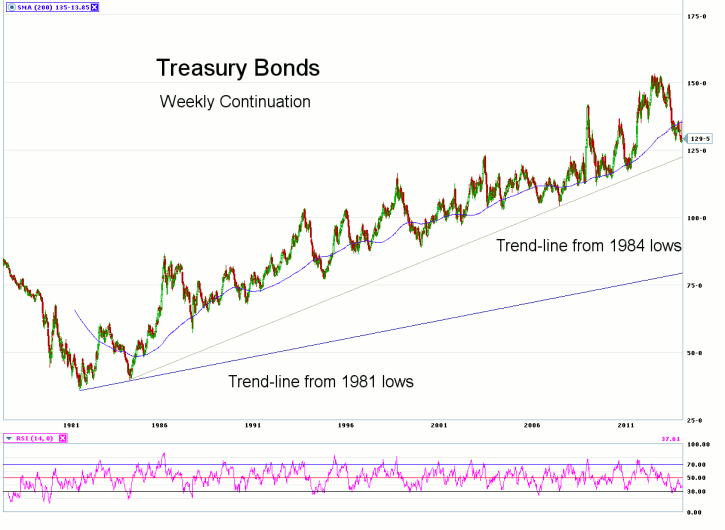
A look at the weekly continuation chart for Treasury Bond futures (US), we notice that despite the over 20-point sell-off from the 2012 all-time highs, Bond prices remain in a uptrend from the lows made back in the 1980?s. In fact, if we look at the trendline going back to the 1984 lows, Bond prices would need to fall by over 7 points from current levels to even test this trendline! Prices are below the 200-week moving average, which does give some bearish bias to the market.? But until prices close below the uptrend line, it may still be too early to call an end to the multi-decade Bond bull market.
 —————————————————————————————–
Disclaimers
This article is provided for informational purposes only. No statement in this article should be construed as a recommendation to buy or sell a security or to provide investment advice. The content provided has been obtained from sources deemed reliable but is not guaranteed as to accuracy and completeness. optionsXpress makes every effort to provide timely information to its recipients but cannot guarantee specific delivery times due to factors beyond our control.
Derivatives involve substantial risk and are not appropriate for all investors. Please read the?“Disclosure Statement for Futures and Options”?prior to investing in futures or options.
For investments using a straddle or strangle options strategy the potential loss is unlimited. Multi-leg option strategies are subject to multiple commissions. Profits may be eroded by the commission expended to open and close the positions and?other risks?apply.