
Successfully speculating in the financial markets can be ?extremely challenging; this is due to all the unknown factors that are continuously present in the markets.? The nature of markets is that nothing is ever certain, and things can change very quickly. ??For us, mere mortals, the concepts of risk, change and uncertainly can be extremely hard to deal with as most of us are not hardwired to accept these as a part of ?daily life. As traders, however, these factors are indeed the reality of everyday life, and as such, a process is of critical importance.
In this week?s article, I?m going to go through three basic steps that should help traders formulate a process.? Obviously, going through the particulars of a strategy is beyond the scope of this article; nonetheless, putting a process together can possibly help get a struggling trader on the right path. So let?s get started.
The first step is to identify where to enter a market with the lowest risk and highest probability. To do this we must look a price chart looking for both supply and demand levels in various timeframes.? The purpose in finding these areas of supply and demand is that we anticipate that when the particular futures market that we?re trading reaches either one of these levels it will reverse direction.?? At supply, we expect the market to turn down, and conversely, at demand it should rally. These are the lowest risk entry points.
In the chart below we see a supply zone in the Russell 2000 Emini contract that was created on Nov 11.? We expect (no guarantees) that the TF (Emini Russell 2000) will turn down when? this zone is reached. This would be our shorting zone. How far it might fall is a function of where the opposing level is determined.? This constitutes our potential profit objective.
?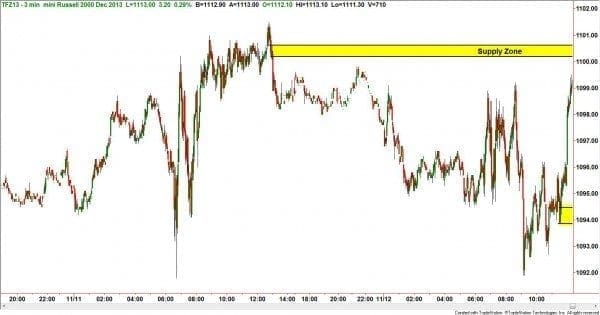
The first step allows us to quantify risk and reward; in this example, the entry at the supply zone, the stop (above the supply) and the target (at the opposing demand zone). ??A key point is that distance between both levels should be far enough away so that even if we?re right a small percentage of the time we can still be profitable. ?Below is the chart of the result.
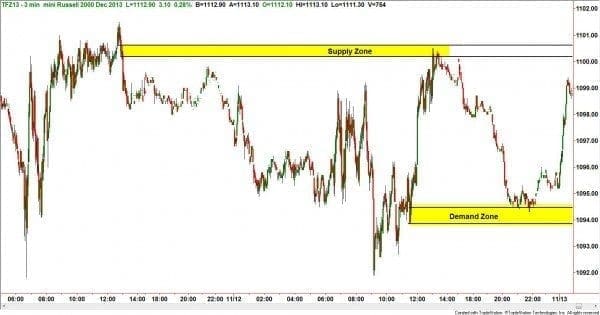
A low risk entry always takes into account the fact that we?re not always going to be right, and therefore if we?re wrong, we will lose very little, which very well could have happened here.
The next step once the levels are found, and the risk to reward is assessed, is simply to place the orders in the market.? This can be done very easily on most professional level platforms. These allow us to simultaneously place (in the above example) a sell limit order to enter the trade, ?a buy stop, and a buy limit order to exit.
The final step is to manage the trade once it is triggered. This can be several steps such as moving a stop with some type of trailing mechanism or can be as simple as moving the stop to break- even once a certain target is achieved.? The most important element in this step is to be as emotionally detached as possible from price movement.? To achieve this it is preferable that the exit strategy is well defined BEFORE the trade is triggered and that it is simple and comprised of a few adjustments.
So there you have it, a three step process that can be replicated and put into plan. Of course, it?s not as simple as I describe here because learning how to identify the highest quality low risk zones requires training and time.?? If you have the motivation to learn we here at Online Trading Academy are here to help.
Until next time, I hope everyone has a great day.