
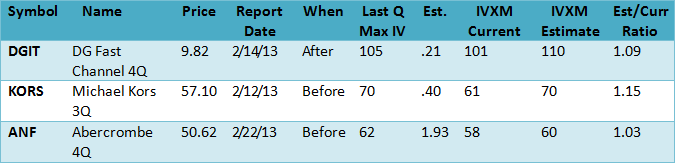
Friday’s Top 5 included three that qualify for our Volatility Kings master list with increasing implied volatility going into their reporting dates. All scheduled to report earnings within the next two weeks so it may be too late for increasing implied volatility strategies before the report dates, but they may be good for declining implied volatility trades after reporting.
?
IVOLopps?
Here is an idea in the momentum category also based upon expected earnings although the next report is not due until the end of April.
Valero Energy Corporation (VLO)
After gapping higher on the January 29 earnings report of 1.82 per share it continues higher without any resistance before 50 where it traded for about six months in early 2008. With all the news about increasing domestic shale oil production gasoline and product prices should be declining, but the opposite is occurring. Some analysts claim the issue is a lack of transportation for the crude oil from the Midwest to gulf coast refineries. Others say the issue is not transportation infrastructure, but refining capacity. If so, the excess supply of light crude oil will not be refined into gasoline due to insufficient refining capacity. This means the light crude oil prices should decline creating better margins for those companies with the capacity to process light crude oil. With 7 gulf coast refineries, including 3 with light crude oil capacity VLO could be one of the major beneficiaries, assuming retail pieces remain high.
If this is the reason the stock price gapped higher on the last earnings report, then it should continue higher. Usually after breaking out above previous resistance, stocks will retest the breakout area, but so far, there is no suggestion of a pull back as it continues higher. Those with strict discipline will want to wait for the expected pull back before entering a new trade. Another approach is to enter one-half of the position size now and the second half after the expected pull back if it occurs.
Since we want to allow sufficient time for the increasing crude oil production to result in excess supply and for the expected price pull back, we suggest using June options. However, after checking the one-year volatility chart we see the current implied volatility at 30 is below the normal range of 35-40 so we need to avoid strategies that are short more options than long in order to reduce the implied volatility risk. Therefore, we can use a call spread or even consider a ratio backspread, which consists of more long (purchased) options than short (sold) options where all options expire at the same time. This means long two OTM options with smaller deltas and short one ATM option with a larger delta.
Our suggestion is the simpler call spread alternative. First, here are the option statistics.
The current Historical Volatility is 41.24 and 26.59 using the Parkinson’s range method, with an Implied Volatility Index Mean of 30.20 up from 29.67 last week. The IV/HV ratio is .73 and 1.14, using the range method to calculate the HV. The put-call ratio is very bullish at .10 with Friday’s volume at 295,183 contracts traded compared to the 5-day average volume of 86,090.
?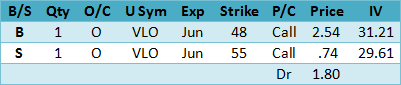
While there is no volatility edge, we have mostly offset the volatility and time decay risk. By selecting a 7-point wide spread, we have one that costs only 26% while increasing our profit potential. If the uptrend continues, as expected it should reach the upper short strike price. Use a close back below 40 (just above the 39 gap) as the SU (stop/unwind). Since we consider this gap to be a breakaway, we do not expect it will decline to 39 and fill the gap.
The suggestion above uses the closing middle price between the Friday bid and ask. Monday, the option prices will be somewhat different due to the time decay over the weekend and any price change.
?
Summary
Since the major indexes continue trending higher with implied volatility near the low end of the range long positions hedged against increasing future volatility should be considered in order to participate in the uptrend while minimizing volatility risk.