
Now being widely reported by the financial media, it is time to update the January Barometer, also called the January Effect. According to Yale Hirsch of the Stock Trader’s Almanac January’s close up or down determines the likely direction of the S&P 500 Index for the year. We updated the numbers to include the January 2013 close along with the year-end 2012 results shown below. Based on this record, there is a 90% probability of closing higher at the end of the year or as they say, there is a 90% probability that “as January goes so goes the rest of the year.”
Here is the updated January Barometer data.
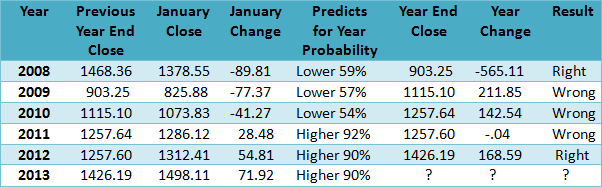
While this indicator produces mixed results in the years when January closes lower the record for predicting higher closes for the years when January closes higher is 90% going back to 1950, based data from the Stock Trader’s Almanac. Since 2011 was almost flat, it was not included in the up year column when calculating the probability.
We begin with the S&P 500 Index (SPX) along with the VIX futures premium and the related options data.
S&P 500 Index (SPX)
The current uptrend, measured from the November 16 low at 1343.35, with the December 31reversal low of 1398.11 making the second trendline point, continues higher as suggested last week. A weak employment report could have been an unbalancing force, but upward revisions for both November and December were interpreted quite positively, so the trend continued higher with some gusto.
S&P 500 Index Implied Volatility (IVXM)
Since our last review, the Implied Volatility Index Mean declined from 10.59 to 10.50, having made a noteworthy low of 10.20 on January 24, while the CBOE Volatility Index? (VIX) increased from 12.46 to 12.90.
The table below shows the VIX cash compared to the next two futures contracts as well as our calculation of Larry McMillan’s day-weighted average between the first and second months.

The day weighting applies 35% to February and 65% to March for an average premium of 16.27% shown above. Our alternative volume weighting between February and March is 14.90%. Up slightly in the last week, the premiums are back into the normal range suggesting somewhat less enthusiasm by professional hedgers to bid the futures prices higher.
Although VIX was virtually unchanged from the week before the futures premium were slightly higher across the entire term structure as both volume and open interest in the front two months increased significantly. On Friday the volume for the February contract expiring on the 13th increased 20,584 contracts while the March volume increased by 27,281 contracts as the total open interest expanded from 415,304 contracts the week before to 434,347 contracts.
iPath S&P 500 VIX Short Term Futures ETN (VXX)
The five-day average volume was 35.48 million shares with 41.7 million on Friday as it declined 1.25 points.
VelocityShares Daily Inverse VIX Short Term ETN (XIV)
The 5-day average volume for the inverse was 12.06 million shares with the greatest volume of 16 million on the 1.10 increase Friday.
When the term structure is in contango, or it slopes upward over time, the advantage goes to a long XIV position since it represents a short futures position and VXX continuously sells the near term contract and buys the next longer term contract at a higher price. The spread between February and March is -1.09 compared to the week before when it was -1.04.
VIX Options
With a current 30-day Historical Volatility of 121.19 and 74.40 using Parkinson’s range method, the table below shows the Implied Volatility (IV) of the at-the-money VIX calls and puts using the futures prices based upon Friday’s closing option mid prices along with their respective month’s futures prices, since the options are priced from the tradable futures.

Using the IV Index Mean of 58.25 the IV/HV ratio is .48, using the range method for Historical Volatility the ratio is .78 while the VIX put-call ratio at .42 is slightly bullish for VIX, but not for the SPX with a put-call ratio of 1.80, since they move in opposite directions. Friday’s options volume was 490,857 contracts compared to the 5-day average of 482,980.
The equity only put-call ratio was .57 making the spread between the SPX put-call ratio and the VIX put-call ratio .15. A narrower spread is market bullish since means the VIX put-call ratio relative to the SPX put-call ratio is lower. As the SPX put-call ratio increases it becomes more bearish while the VIX put-call ratio is more bearish (for the SPX) as the ratio declines making the spread between them wider.
All of the Implied Volatilities along with the Historical Volatilities and Greeks for the VIX options based upon the futures prices are on our Advanced Options page, found by clicking on the “market close” link shown near the top of the page.
iShares Barclays 7-10 Year Treasury (IEF)
After closing below the previous support at 106, interest rates continue higher, now at 2.01% as equities moved higher as well, both signs of improving economic expectations. Support for IEF (resistance for 10-year rates) is the March 19 low at 101.83 or 2.39%
US Dollar Index (DX)
Returning to the lineup, the dollar index is just below the midpoint of its 5-year range between the March 17, 2008 low at 70.70 and the March 9, 2009 high of 89.46. Expectations of improving economic conditions should make the dollar more attractive thereby increasing the dollar index, but the opposite is occurring. Perhaps this suggests the sale of US dollar reserves held in other countries and the redeployment of the proceeds into productive assets once again. As the decline continues, watch the 74 level where it found support from April to September 2011.
iShares Dow Jones Transportation Average Index (IYT)
As probably the single most important leading indicator for the economy, the uptrend in the transports continues after a brief pull back before Friday’s employment report. In addition to being an important Dow Theory confirming indicator the transports deserve close attention as a leading indicator as they continue trending higher having surpassed the previous high of 101.60 that defined the 10-year trading range from the March 2009 low at 38.28. The transports imply the equity uptrend will likely continue.
NYSE McClellan Summation Index
In the two weeks since our last review, the market breadth indictor advanced another 192.22 points, with only 36.24 point of the advance occurring last week as the momentum slowed considerably. On February 10, 2012, this index was 1325.47 when the SPX was 1342.64 or 170.53 points lower. Ideally, the market breadth should confirm the major indexes highs, so the breadth divergence is a concern.