
It did not take long for speculators to see an opportunity to profit from anticipating the direction of these prices and capitalizing on these moves.? While speculators (small traders, hedge funds, Commodity Trading Advisors (CTA) etc) are known for disrupting good market trends and causing excessive volatility they are actually welcomed by the Commercial trader.? As a speculator we are the vehicle that moves prices from one type of Commercial (Producer) to another type of Commercial (Processor).
Imagine if a Producer of a Commodity and a Processor of a Commodity had to conduct transactions with each other.? Keep in mind that a Producer is trying to lock in very high prices by selling Futures contracts against their cash product they already own in case prices drop before they deliver the product.? The Processor is trying to lock in low prices by buying Futures contracts prior to taking delivery of a Commodity at a future date.
Since both types of Commercial traders have different objectives there has to be a way to get the price to each of these parties.? Otherwise the prices we as consumers would pay would be extremely high, much higher than we pay now for everyday products.? If a Processor had to pay the higher asking price the Producer is asking don?t you think that would reduce their profit margin?? To make up for the lower profit margin the Processor would have to raise the price considerably that they would charge the end user ? you and I the consumer.
Speculators tend to follow or create price trends.? These trends always terminate at some price point.? Even though most speculators think the trend will never end, they always do.? The termination of these trends are usually the result of Commercial traders absorbing all the supply or demand (depending on if it is an uptrend or downtrend) based on the Commercial trader?s needs in the market.? If a Commercial Producer feels prices are relatively high they will sell as many Futures contracts as they can to lock in the higher prices.? This selling will absorb the?demand in any uptrend and eventually when there is no more demand the price will drop. The same holds true for the Processors, when prices are in a downtrend they will step up and buy as many Futures contracts as they need to lock in that low price for future delivery of that Commodity.? This buying will absorb the majority of the supply in the market and a new uptrend will result.
The result of speculators causing prices to trend to both types of Commercial traders is what helps to keep our daily food, clothing, energy, interest rates, housing, etc prices at relatively inexpensive values.
When trading Commodity Futures we are dealing with leveraged accounts.? This means that we are trading contracts that have a nominal value anywhere from $30,000 to $250,000 each.? We get leverage from depositing small amounts of capital called margin.? This margin is generally 3 ? 9% of the total contract value, sometimes more in extreme volatility.
The funds we need to use for this margin are deposited with a Futures Commission Merchant (FCM) when you open your trading account.? They are highly regulated by the Commodity Futures Trading Commission (CFTC).? Once the FCM receives your funds they are deposited in a segregated bank account such as one at Harris Bank in Chicago.
These funds are put into an account under your name (segregated) so that the funds are not to be comingled with the FCM?s funds they need to run their business.? By segregating your funds this protects your funds from any FCM failure or possible lawsuits against the FCM.? In over 200 years nobody has ever lost money due to an FCM failure.? Recently we have had situations with MFGlobal and PFG Best where customers have not received all of their funds from these defaults.? As of this date the investigations continue into finding these missing funds and returning them to the clients.? Our Futures industry cannot stand to have clients losing funds due to situations that came about in these two FCM?s.? To protect the integrity of the Futures industry many feel the CMEGroup (world?s largest Futures Exchange) will step up to replenish customer funds for any losses beyond what the trustees of the FCM?s payback.
You might be asking that if our accounts are segregated then how did the firms get their hands on the money to lose?? FCM?s like any other company have expenses to operate and obviously like to increase their balance sheets with any revenue they can.? Years ago we paid a lot more for commissions than we do today.? I used to pay a ?discounted? rate of $40 per contract.? And that discount was because they extended a professional courtesy to me because I had my series 3 brokers license and was registered as a CTA.?Also, the interest rates for T-bills and other products were much higher and this allowed firms to collect extra revenue relatively risk free.
Today commissions are much lower as deep discount brokerage firms offer trades for as little as $2.50 round turn.? And in case you had not noticed interest rates are at such depressed levels that even people with large sums of money cannot survive on fixed income returns anymore.
Rumor has it that this is what lead up to the failure of one of these FCM?s.? They were using customer segregated funds to invest (trade) in junk bonds in Europe trying to get a larger return for their firm because the interest rates for junk bonds were extremely high compared to the rates in the United States.? The difference being is that the United States guarantees the principal will never be lost, Europe on the other hand does not and did not have the same guarantee.
You are probably still asking how they could get these customer funds so readily?
Most all brokerage firms in the United States, Stock or Futures will use funds of clients to invest in U.S. Government securities almost daily.? Shocking?? And here we thought our funds were just sitting in our account doing nothing.? The CFTC is aware of this practice and has very strict rules on what products these FCM?s are allowed to invest in.? The list includes only products that are guaranteed by the U.S. Government.
Figure 1 shows a pie chart of how one FCM, Rosenthal Collins will invest customer funds.
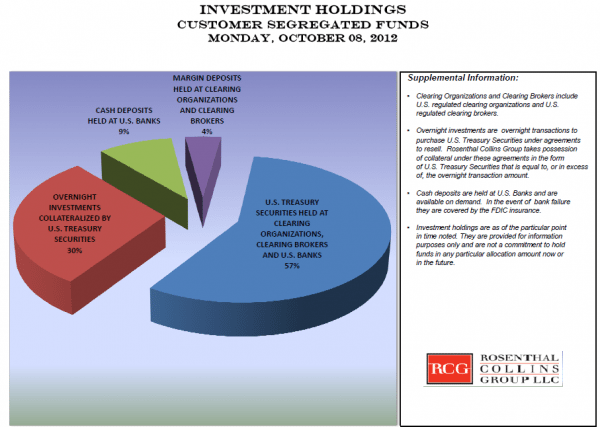
Figure 1 (source)
This practice has been used for many years by both small and large firms.? And until recently there was never a problem with the safety of our funds.? I still believe that the track record of safety speaks for itself and that the industry does a great job regulating these practices.
That said there are a few things that we as traders can do to protect us against future events that could freeze your funds:
- Always check the National Futures Association website to verify the integrity of the FCM you are depositing your funds at.
- As a professional trader we cannot afford to have all of our working capital tied up if our funds are frozen.? I would recommend having different brokerage accounts at ?different? FCM?s.? Remember, FCM?s represent many different brokerage firms and it is possible that the two accounts you have might still be cleared by the same FCM, always check.
- There is no need to deposit $200,000 in your trading account.? You are not earning anything on this money.? I would recommend you have a minimum amount in at least two separate brokerage accounts.? The extra money you have, risk capital to trade with can be deposited in a money market and earmarked for Futures trading.? Then as you need extra cash for trading more contracts or liquidity reasons you can wire the funds to your brokerage account as needed.
?Judgments prevent us from seeing the good that lies beyond appearance.? -?Wayne Dyer
Happy New Year and let?s make this a year to remember.
Don Dawson