
As I watched the market on Friday, most of the volatility was coming from AAPL.?? Traders still cannot get past the fact that AAPL has changed into a slightly different stock lately.? This is something that I call a change in ?personality?.? Specifically, is the realized volatility the same as it has always been or has it become something else?? AAPL does not normally stay at this level of realized volatility for this long.? It is usually a gap and then pretty much mid to low 20?s in realized volatility.
10-day realized volatility in AAPL is hovering around the 40% level, and as of Friday the stock is showing no signs of giving that up.? Implied volatility in AAPL, measured by the AAPL VIX (VXAPL) was up three full points Friday morning.? If you want to see where all the buying is located, take a look below.
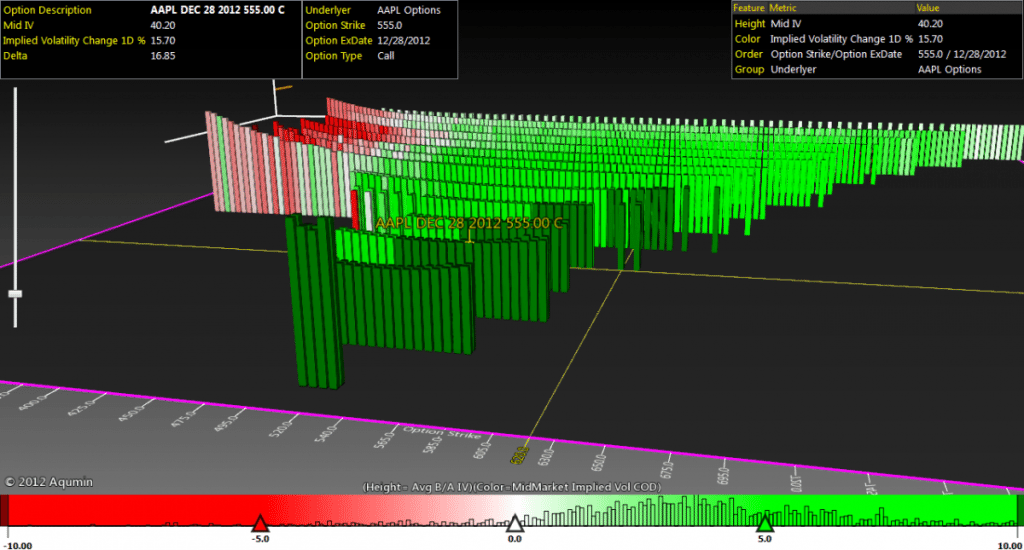
The OptionVision landscape helps identify how the skew is changing in AAPL.? Most of the upside calls have been getting the action.? The OTM calls are actually increasing in volatility faster than the OTM puts. ?If you look below the dark green strikes are up 10% or more.? Note all of the dark green increases on the calls are pushing the skew almost parabolic on the upside.
?
As AAPL dances around the $512 level buys are still bidding up calls as the legions of AAPL believers come in and play the next bounce.? AAPL could well bounce and most likely will be the beneficiary of any progress on debt talks.
The Trade
?If you must get long selling OTM put spreads (475 level or lower now) make more sense if (and a big if) the IV starts to cool.? Take your time in entering since the stock is still moving around a bit and keep the allocation small.? Keep the spread to no more than $5 to control risk.? A better idea might be a small iron condor with at least 50 points away from the ATM in both spreads in the Jan (pre-earnings) cycle.?? With AAPL moving like this I would keep the allocation much less than normal.