
Last week, we proposed the correction was due to election uncertainty, but now after poor earnings reports from three large multi-national companies in the Dow Jones Industrial average, it appears the issues are earnings uncertainty including a slowdown in Europe and currency translation.
S&P Capital IQ says they expect companies in the S&P 500 to post their worst earnings results since the third quarter of 2009.
In this issue, after a brief strategy comment, we announce the addition of daily options & open interest to our data tables, and then update our VIX futures premium indicator. Next, we report our portfolio results for the regular October options expirations, followed by a new trade resulting from the assignment of Amarin Corporation plc (AMRN) stock. Finally, we offer a conditional PowerShares QQQ (QQQ) hedging suggestion.
Strategy
S&P 500 Index (SPX)
Referring to the chart last week, SPX has closed below the upward sloping trendline (USTL) that began with the June 4 low at 1266.74. In addition, last week’s rally that reversed Friday created a possible triple top requiring a close below 1426.68 for activation, just below the current level. In that event, we will use the double top minimum measuring objective described last week to determine the minimum measuring objective MO of 1388, shown on the chart in last week’s post.
If the decline continues, then the VIX will increase along with the implied volatility of individual stocks so consider using long straddles and strangles for the Volatility Kings listed in previous posts.
S&P 500 Index Implied Volatility (IVXM)
At the end of last week, the Implied Volatility Index Mean increased just .03 from 14.23 to 14.26, while the CBOE Volatility Index (VIX) increased from 16.14 to 17.06
The table below shows the VIX cash compared to the next two futures contracts as well as our calculation of Larry McMillan’s day-weighted average between the first and second months.
?
The day weighting applied 88% to November and 12% to December resulting in the average premium of .64 or 3.76% shown above. Our alternative volume weighting between November and December is a 4.76% premium. Last week the day-weighted premium was 10.58%, while the volume weighted was 7.51%. Fridays’ volume was 135,194 contracts with an open interest of 389,616 contracts compared to 149,114 contracts traded and 419,966 contracts open interest the Friday before. Both the volume and open interest declined and the premium levels are the lowest in many weeks.
For this short-term indicator the premium to the cash is a SPX sell signal suggesting professional expectations for the cash to increase toward the futures price. In the past premiums in excess of 20%, have usually preceded corrections, although not a precise timing tool it appears to be a good way to measure professional hedging sentiment. The current level suggests a significant decline in hedging activity last week.
Update
Last week we began adding both the daily volume and open interest to the data tables at our complimentary Basic Options, Advanced Options and Advanced Historical Data pages. Located to the right of the stock volume, users can now easily compare volume and open interest against the one-week averages, making it easier to identify active option activity going into an earnings report, a takeover rumor or other events. Updated in the evenings after the close they will be available before the market opens the next day. Since Advanced Options also provides intraday data, the previous day’s volume and open interest continues displaying until updated after the close each day and available when clicking on the “market close” link.
Since we had an unusually large number of options position expiring on the regular October expiration last Saturday we began closing the oldest ones Wednesday and continued Thursday and on the close Friday. Since none were offsetting hedges almost all were profitable. In total there were 16, all one-lot positions, many more than we usually carry to expiration. The final tally was one 143 loss, one stock position assigned from a short put and 14 gains ranging from a low of 2 to a high of 388 with a median of 93.
The assigned stock was Amarin Corporation plc (AMRN) 11.26 resulting from a short October 12 put position suggested in Digest Issue 40. The initial credit was .75 so our basis is very close to the current price after deducting the put sale proceeds from the assignment price of 12.
Refreshing our memory we note the company received FDA approval for Vascepa, a treatment for high levels of triglycerides, but a brokerage downgraded it since it had not yet received an acquisition bid. Since the implied volatility remains high and rising, expectations remain high.
The options details follow,
The current Historical Volatility is 51.51 and 53.20 using the Parkinson’s range method, with an Implied Volatility Index Mean of 119.02, up from 111.57 last week. The IV/HV ratio is 2.31 and 2.24 using the range method to calculate the HV. Friday’s put-call ratio was in bearish territory at 1.00, on a sudden decline in call volume. The total volume was 8,842 contracts traded compared to the 5-day average volume of 13,970.
We notice the implied volatility is rising, last month is was 93.27, which means expectation and/or uncertainty is rising. With the favorable IV/HV ratio of 2.24 we suggest selling more options so here is a strangle adjustment suggestion.
Since we are long 100 shares of stock, we can sell an out-of-the-money call. In addition, we also want to sell an out-of-the-money put below the most recent pivot at the support from last May before the FDA approval.
?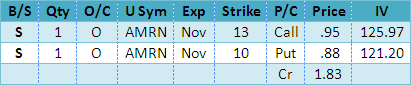
Although the implied volatility is still rising, the November options will soon be losing time value rapidly. In the event both expire worthless, our basis in the stock will be 9.42 below the May support level. The risk is assignment of another 100 shares in the event it closes below 10 at the November expiration.
Hedge
Since the SPX has closed below our upward sloping trendline detailed above and shown in last week’s chart, it is time to consider implementing a hedge and because there seems to be a low level of concern about a further decline from our VIX futures premium indicator, we want to make it conditional.
PowerShares QQQ (QQQ)
While the QQQ also closed below its upward sloping trendline, it has been weaker than SPX for the last few weeks. There is considerable support at 65 so we suggest using a close below 65 as the first condition.
The second condition is for the SPX to close below the August 21 support at 1426.68 mentioned above. If both conditions are satisfied early this week then consider this hedge.
First, the relevant options data,
The current Historical Volatility is 14.28 and 11.67 using the Parkinson’s range method, with an Implied Volatility Index Mean of 18.25 up from 16.99 last week. The IV/HV ratio is 1.28 and 1.56 using the range method to calculate the HV. Friday’s put-call ratio was bearish territory at 1.58, but within the .75 to 2.50 range since it is a hedging favorite. The volume was extremely high at 866,677 contracts traded compared to the 5-day average volume of 488,190.
?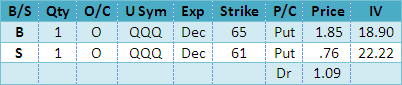
At 27% of the width between the strike prices, it has a good volatility edge and risk reward ratio. In the event both conditions are satisfied use a close back above the last pivot at 68.30 as the SU (stop/unwind). If the decline continues, it should provide an effective hedge since we only have 2 November positions from previous Digest issues, one a straddle and the other a put spread.
Summary
This week may begin much like last week after the second sharp decline in as many weeks. However, since the market is squarely focused upon earnings, more disappoints will mean a further down leg, but since the VIX premium indicator is not suggesting great concern it could just as easily rebound just like last week.