
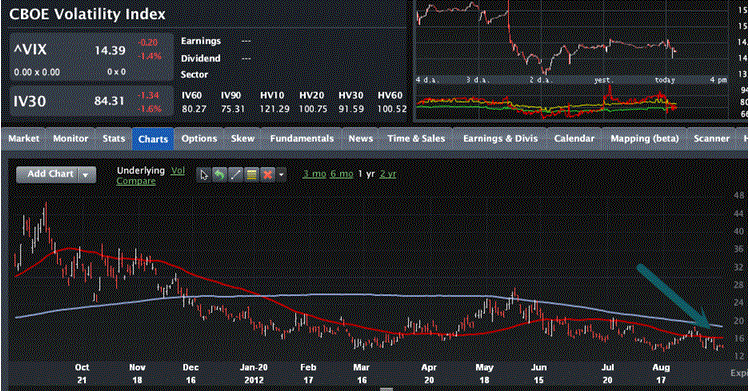
The VIX.? The Volatility Index.? The Fear gauge. We see that it sits at 14.05, near the lowest levels of the year. This makes many seasoned options traders nervous. The red lights are flashing. Why? Complacency in the market is a very dangerous sentiment and many believe that the markets are whistling past the graveyard.
? Source: Livevol(R) Pro (www.livevol.com)
We have seen this movie before and the ending is not always so pretty.? A combination of an upward trending ?what me worry? market, low interest rates, accommodative fed policy and a complacent public has all the ingredients for a classic recipe that can produce a sudden and unexpected dramatic selloff in the markets.?
The slowly ascending indices have dampened demand for options and implied volatilities have subsequently plummeted. The prevailing contentment leads many retails customers to become wary of buying options. Many muse ?why buy protection when the market is only going to go higher?.? Don?t be caught off guard.? Protect your profits before the price of protection becomes exorbitant.
A simple analogy for option protection pricing is home insurance.? The best time to buy home insurance is before the house catches fire. When your house is burning down, insuring your house will be cost prohibitive. Similarly, option prices are currently muted, but may not remain depressed forever.? When the worm turns (and it will with the slightest of dark skies) the cost of market insurance will dramatically escalate. ?
Remember this maxim and you will be served well in your investing career:? When implied volatility is curiously low, risky times may lie ahead. Be prepared.
Now some background????.
What is the Vix?
The VIX estimates the implied volatility of the S&P 500 index over the next 30 days.? The index doesn?t trade like an underlying because it?s only a measurement.
In theory, it measure prices for a range of options on the S&P 500 index.
The formula uses a calculation that takes as inputs the current market prices for some out-of-the-money calls and puts for the front month and second month expirations.
It is commonplace to hear commentators discuss how the VIX ?implies? that the market could move a certain percentage on a daily basis.
For example, a VIX of 16 supposedly means that it would not be unusual for the market, or more accurately the S&P 500, to move about 1% in one day. What does that mean ? and how do you calculate this percentage?
To calculate annualized volatility, you take the square root of the number of trading days in a year (252), which is 15.87. ?
To get the expected future standard deviation that?s predicted by the VIX, you must divide the VIX (14.04) by 15.87. ?
So if the VIX is at 14.05, the standard deviation of the implied future price changes in the S&P 500 is .008% or less than1%.
?? ?
What to do?
The depressed volatility environment presents some compelling strategies for investors who want to take advantage of these volatilities to either initiate a new bearish position or hedge an existing long position at a discounted price. Use this low volatility environment as an opportunity to enter into new positions at cheap prices. ?
There have been studies that have shown that the VIX has move in the opposite direction of the market(S& P 500) almost 90% of the time. Even more revealing is the fact that when the equity market has fallen over 3%, the VIX has typically risen by 17%.? That?s some hedge.
Trade idea –A Bearish Options Protection Play
The recent market upswing and the volatility decline provide an opportunity to buy $SPY (SPDR? S&P 500 ETF) out -of -the money puts that will be in-the-money if the marketplace retraces back to trading prices just a few weeks ago. The prices of these puts are now lower than they have been in the recent past and provide compelling limited-risk trades.
The low reading of these options and the VIX is usually a bearish sign indicating contentment and complacency in the marketplace. This sentiment can be quite dangerous as it often breeds false sense of security for the individual investor. ?
We need to determine the correct month to purchase your put hedge.? Upon review of the different SPY option series, we find that December 2012 monthly options present some interesting medium term value.?
Why December?
You may wish to hedge the rest of the calendar year since the market has risen over 23% in the last year. There has also been recent geopolitical turmoil (Middle East unrest) and there is continued uncertainty in the November elections. ?
This is not a specific trade recommendation, but a trade analysis.
The play:
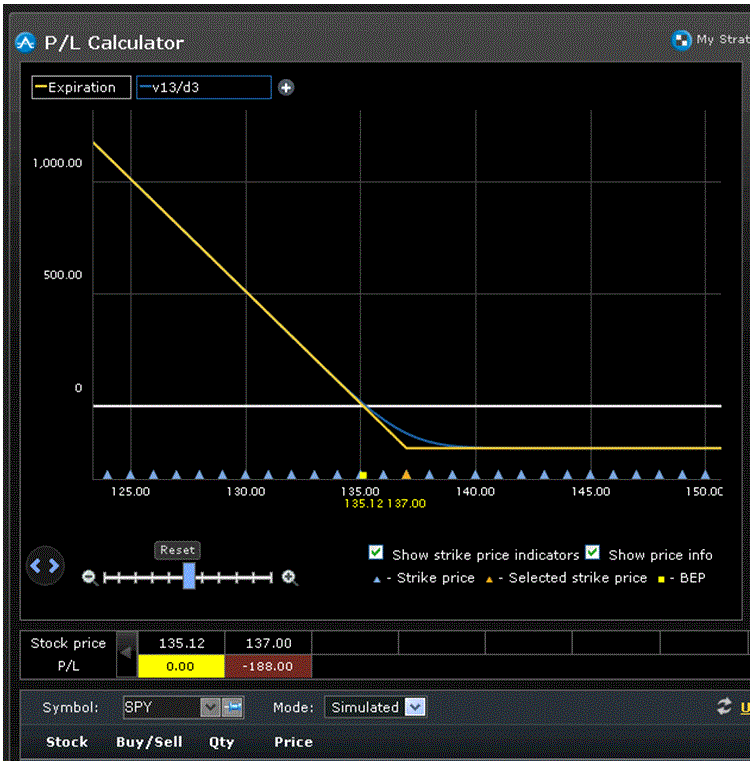
a)?? ?Buy December monthly 2012 137 strike puts for $ 1.88.? This is approximately 17.2% implied volatility.
Net debit: $1.88
Risk:? You lose the entire premium if SPY closes at $137.00 or above by December 2012 expiration.
? Source: http://sogotrade.com
Why the 137 Strike?? There are several reasons that this strike was chosen for our hedge.
1)?? ?This strike represents an approximately 6.5% retrenchment in SPY over the remainder of the year. This should provide adequate protection without breaking the bank.
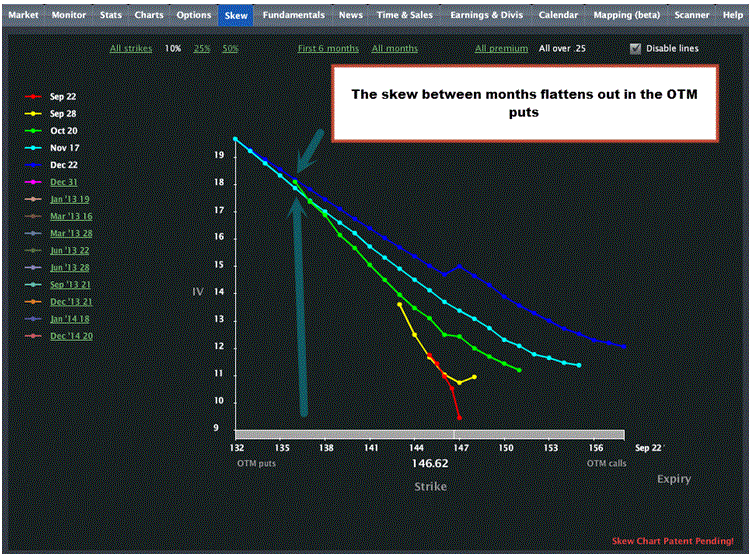
2)?? ?If we closely examine the skew between the different expirations, we see a normal monthly pattern. However, this normalcy breaks down or converges around the 137 strike.
Let me explain.? When implied volatility decreases sharply, normally the front month options contract the most severely and the back months (further out) retain more of a historical mean value.? In the chart below, we see exactly this pattern.? The nearest expirations (red, yellow, green etc) are the cheapest while the further out months have retained more implied volatility value.? However, this skew between the expirations flattens out around the137 strike.? In essence, we can buy the December 6.5% out-of-the-money puts for nearly the same implied volatility as the nearer expiration options. ?
Conclusion: We get protection through December expiration for a reasonable amount of premium and a fair implied volatility skew.
?
Source: Livevol(R) Pro (www.livevol.com)
Stay tuned???
Note: The Prices are quoted at time of submission and do not reflect current market prices.
Disclaimer
________________________________________
We are not liable for any trading decisions made by any reader. NO advice is given or implied. The information offered in this article is for demonstration purposes ONLY and should not to be either construed as an offer or considered to be a recommendation to buy or sell any options.
Your use of this information is entirely at your own risk. It is your sole responsibility to evaluate the accuracy, completeness and usefulness of the information. You must assess the risk of any trade with a professional broker, or financial planner, and make your own independent decisions regarding any trades mentioned herein. This is not a solicitation to buy or sell any options, or to purchase or sell any credit spreads. Trading options only carries a high degree of risk, is not suitable for all traders/investors, and you may lose all of your premium money invested in the options. If you have never traded options before, we strongly recommend that you read a little background information made available by the government. Only you can determine what level of risk is appropriate for you. Also, prior to buying or selling an option, a person must receive a copy of Characteristics and Risks of Standardized Options.
Past performances DO NOT guarantee future results. Please consult with your own independent tax, business and financial advisors with respect to any trade. We will NOT be responsible for the consequences of anyone acting on this purely demonstration material.
Important Note: Options involve risk and are not suitable for all investors. For more information, please read the Characteristics and Risks of Standardized Options.