
Comparing Bear Call Spreads
This article will look at four different short vertical call spreads on the same underlying in order to distinguish which call spread is most suitable.
In the options class I recently taught at our New York City Center, a ticker was discussed that had extremely high implied volatility (IV) and was in a strong downtrend. Once the chart was looked at it was clear to all of us in the class that Groupon (GRPN) had broken through its demand zone and was in a clear downfall. Instantly, we started to examine possible spread trades.
Online Trading Academy?s Professional Option Trader course teaches that when I.V. is high, in the fourth zone of our volatility thermometer, credit spread trades are considered the correct option strategies to utilize since they will take advantage of IV returning to the norm.? In GRPN there was an issue regarding the price of the underlying. In our Pro-Trader class we suggest that students stay away from trading stocks that are less than fifteen dollars and less than one million average daily volume.? For GRPN an exception was made, for education purposes only. Currently the general market?s IV is somewhat low which makes it extra hard to find underlying products that are at the other extreme, high.
 Figure 1: On the day we looked at GRPN, its IV had just broke the 52 week high historical volatility
Now, let us look at the four different short vertical call spreads that were looked at in class and see what the differences were amongst them.
First Example
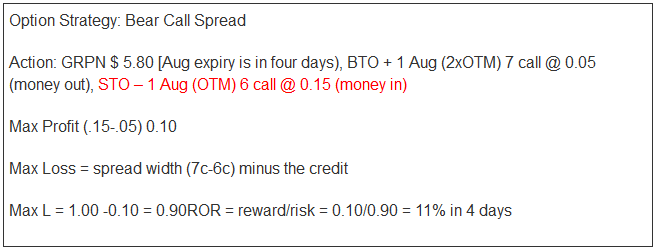
The first example involved doing the Aug 6/7 Bear Call Spread:
 Second Example
The second example looked at the same strike price but different expiry, Sep -6c/+7c.
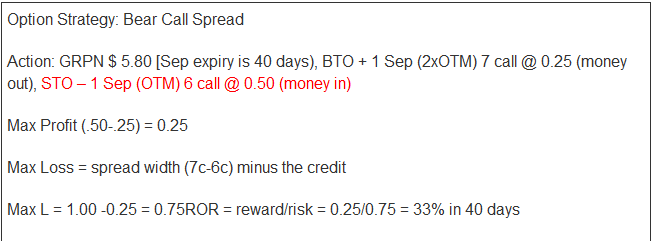 The main differences between these first two would be the time until expiration, 40 days versus 4 days, as well as the rate of return.
Third Example
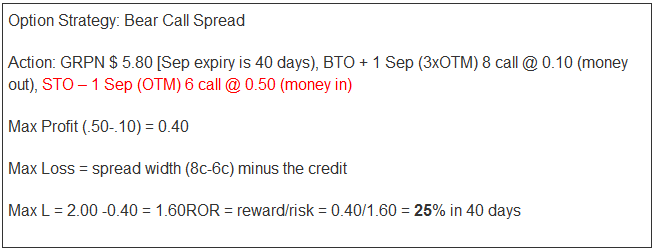
The third example used the same expiry as the second but the strike price width was widened out from a single point increment to a two point increment, namely Sep -6c/+8c. The logic behind this is that based on the technical forecast, the upper leg will be going out worthless anyways; therefore, why not select one that allows us to keep a bit more premium.
 Fourth Example
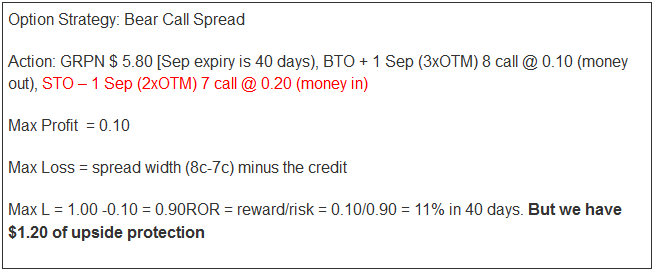
In the last example we have kept the same expiry of September but have chosen to select the sale of the 7 strike price in order to get more upside breathing room. In other words we have a spread that is more conservative than the previous ones.
 Prior to analyzing all four spreads side by side with certain criteria, we ought to be aware of the possible outcomes. A lot of traders know that the market can do three things (go up, down, or sideways) yet in our case, as the sellers of short vertical credit spreads, there are two extra scenarios? possible.
Figure 2 clearly lists the five outcome possibilities for GRPN from $5.80:
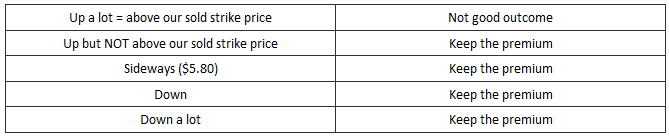 Figure 2: The only losing outcome is when GRPN goes above our sold strike price
Having clearly emphasized this point, let us make sure not to get side tracked by anything else except our protection from the upside. Figure 3 below shows various criteria, such as Rate of Return, money at risk, maximum profit, and most importantly upside protection while GRPN is at $5.80.
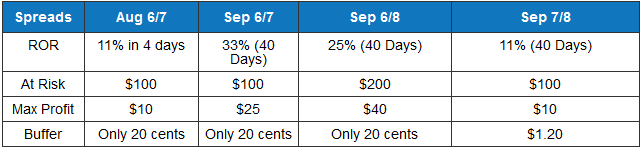 Figure 3: The main focus is the upside protection, or Buffer
In conclusion, this article has looked at different short vertical call spreads in order to distinguish which of them could be most suitable. Although all four of the spreads were done on the same underlying, we explored different time durations, different strike price selection, and consequently different risk exposure. Which one to select amongst the choices presented ultimately comes down to an individual trader?s decision based on? whether the trader considers himself or herself aggressive, moderate, or conservative. After all, we are trading options which have in themselves multiple possibilities. The goal is not so much which spread trade to select but rather which spread trade to stay away from; hence, choose wisely and have green trading.